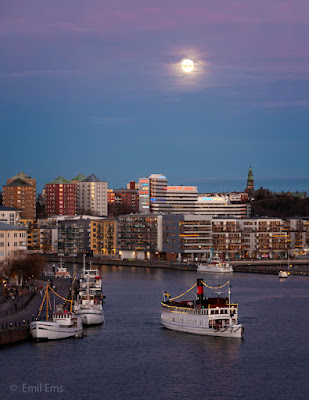
In August 2009 I moved back to Stockholm after having lived in Brussels for more than ten years. This blog describes my fresh impressions from the agreeable landscape surrounding my new apartment in Hammarby Sjöstad, so easy to catch on camera from my kitchen window.
This is the time of year when darkness encroaches on us. Around 5.30 pm, the dying sun casts its last rays on the balcony opposite mine, signalling drab times ahead.
Time has passed since you last heard from me on this blog. You may have surmised that I have also entered a twilight zone, that of late age, and laid aside my camera and pen. Far from it! I have been busy finalising another blog, dealing with my family name and our namesakes. Alas, only German-speaking readers have benefited from this work. Spurred on by my brother Ludwig, who pointed out that most of our relatives struggle to understand Shakespeare's language, I gave in and published that blog in my native tongue. It is now finished, and you can inspect its final chapter here.
This turned out to be a major undertaking, and I am glad I lived long enough to get to grips with it. Here you can see me surrounded by some of the literature and material I had to wade through to do the necessary groundwork. Still, much remains to be done, since I plan to turn the blog into a book!
Producing the book will keep me occupied during much of the coming year. But thereafter, health permitting, I will translate the blog into English so that all you trusted Readers can sample my efforts.
I am starting to realise that, of all things, only work remains for an old-timer who wants to stay reasonably fit despite age catching up with him. Work is a sure way of combating the morosity that otherwise tends to overwhelm an octogenarian. To see what I mean, why not sample this bittersweet tune, which I discovered before I even turned twenty; I am equally fond of it now, but for a different reason. Then it mirrored the feeling of entering a strange new land that would eventually become my new homeland. Nowadays, it resonates with my yearning for my younger days, while also feeling like a stranger in that strange land of getting old and fading away.
"Sakura" is the Japanese word för cherry blossoms, if I remember correctly. And there will be Sakura aplenty soon in my neighbourhood. Every end of April, the same miracle occurs: within days, the whole quarter is in bloom. But why waste words to describe it? Have a look at this video instead, which I took some years ago. Doesn't matter! You only have to click at the picture to see it. The same sceneies can still be admired "al fresco” throughout this week. Enjoy!
We are having an exceptionally prolonged cold period here in Stockholm at the moment. Temperatures rarely rise above -5°C, even mid-day. The sidewalks are icy and hobbly, due to notoriously bad snow clearing in our town. Best to put on rough-soled shoes and carry several layers of underwear when daring to venture out into the freeze.
Hammarby Canal is frozen over, as can be seen in the title picture above. This view is rare, though, since ship traffic is still going on, breaking the ice in daytime. In the second picture, a boat has broken through the ice maybe an hour beforehand, and the damage is already being repaired at the icy temperature.
At 9 am on February 3
It takes at least a couple of boats per hour to keep the throughway reasonably open. Still, each ship has to crunch through the newly formed ice, as soon as a quarter of an hour has passed since the last one. I hear the occasional crunching in my apartment, even with the windows closed; it is a rather distinct sound that carries far.
This type of weather may appear exceptional and harsh, keeping in mind the series of essentially snow- and frostless winters we have been experiencing lately. But, going back in time a decade or so, winters could be much colder than that. I only have to look at my earlier blog posts to realise this. For instance, have a look at a post of February 2011. Then, the temperature hovered below -20°C, and my glove froze to the door grip of the press shop I tried to enter!
At 10.30 am on February 3
Still, with not much to do and being quite content to stay out of the cold in the cosy warmth of my apartment, the mind tends to wander and dig up bits and pieces of insight that have been soundly buried in my ageing brain.
Take the title of this post, which happens to link to the one just preceding it.“Fimbulwinter" is a term from Old Norse Mythology, indicating a period of strong cold. This period is supposed to precede “Ragnarök", the End of the World. In the words of Edda (the Icelandic collection of myths):
First comes the winter called Fimbul. Snow drifts from all directions, it gets very cold and icy winds are howling. The Sun has lost its shine. Three winters come without Summer in between.
Strangely enough, this myth of loong darkness is accompanied by the appearance of the blood of the Gods being spilt by Fenris the Wolf, that is, blood red bands on the sky, as if Fenris were chasing the Asa Gods to oblivion:
He (Fenris) fills himself with the blood of his victims, paints the Abodes of the Gods red with blood. Then the Summers are dark, all weather deadly.
Lest you start smiling condescendingly at the superstitions of the old Norse, let me tell you that these concepts of Fimbulvinter are but vague collective memories of a catastrophe that befell the North about 1500 years ago. We can even be more precise. It occurred in the years 536-37 and continued unabated for another decade.
In early 536, there was an enormous volcanic eruption in Central America. It created a sulphurous dust cloud that spread over the Northern Hemisphere and stayed on for two seasons. This semi-permanent sky cover had the effect of reflecting away the sun's rays from Earth. Seen from the ground, the sun was barely visible, even if at its highest position in Summer. Paradoxically, the western evening sky was often dramatically coloured in blood red, due to the setting sun shining on the sulphuric cover from below.
Fenris, the mighty wolf, gorging on the sun and mauling the Gods Composite, based on a picture by Louis Moe
The northernmost regions in Europe, Fennoscandinavia, that is, suffered most in those terrible years. Imagine experiencing two years without any harvest whatsoever! The first year could be managed by eating up all the remaining grain and the starving animals. The second year would cull the population by death through starvation. In fact, the Northern part of Fennoscandinavia – essentially the regions North of present-day Oslo, Stockholm and Helsinki – became void of humans. Further South, at least half of the inhabitants died of hunger.
This was not all: For ten years thereafter, volcanic outbreaks continued, albeit of lesser intensity. At the end of this period, civilisation in the North was no more. It took a century or so for a new civilisation to rise from the ashes: The birth of the Viking era. For these survivors, the memory of the terrible years did not fade. Far from it, there lingered a constant dread and fear that the catastrophe could return at any time! From that trauma, ever fearing collective death through starvation in a world devoid of light, arose in time the Myth of Ragnarök (End of the World), foreboded by Fimbulvinter. Not surprisingly: If you, as a Northener in the 6th century AD, recall that more than half of your countrymen died in the years of the great famine, it is not far-fetched to imagine that a recurrence of the event will kill you all. Thus, one of humanity's greatest Myths was born, and the most recent of them at that!
Traces of the Myth are still surviving in the great epics of yore: the Edda, Beowulf, and even Kalevala in the far Northeast! Something to read and think about, when renewed cold weather is keeping us at our hearth!
When I was a youngster, I was often amazed at oldtimers saying, “I don’t understand the world any longer!” Hadn’t they over the years learnt the lesson that the world was ever changing and that you had to adapt to the changes? To my surprise, I have begun to nurture the same feeling this passed year! There is hardly anything left from the world of yesteryears, a world I had learned to love and live cosily within! I should, of course, have seen it coming; the whole last decade was nought but a build-up of events that led to his new world! But the past twelve months have made it clear that this buildup has become inevitable, that a profoundly changed world is here to stay.
The global superpowers have ceased to pretend that there is international law and order to bind them all. Instead, they are playing a brutal geopolitical power game at the expense of smaller nations, not to speak of the peoples of the planet. The great oligopolies in traditional energy markets have finally succeeded in manipulating public opinion, driven by totally corrupt political moguls (at least one of them), and, as a result, the inevitable shift away from fossil fuels appears to be slowing, if not coming to a complete standstill. Our own politicians in the West are forever luring their voters into believing that all government expenses are a free lunch, be they military build-up, climate actions or ever-increasing welfare benefits, and that there is absolutely no need to prioritise and keep public budgets under control. In Europe, productivity has come to a standstill, with the enterprise sector more content to accept subsidies than to do its job of innovating and advancing production processes.
As a result, I have a strong feeling that a perfect storm of political, natural, and financial crises is brewing and may erupt into chaos in the near future. Let us hope that the inevitable eruption does not occur next year, so that we can enjoy at least another twelve months of personal peace and happiness. In this sense, I invite you to join me in a solemn prayer for a
The passing of time really affects our understanding of life, doesn't it?
Have a look at the enclosed picture! I took it fifteen years ago at the start of my life as a retiree. Then, it felt like a new beginning, and my view of the picture mirrored that. To me, it seemed to show an open sea of opportunities, which I had finally reached, just like the boat was reaching the open waters after laboriously fighting through the ice.
This was my view then. Now, as a newly baked octogenarian, I am looking at the same picture, but my impressions are somewhat different. It is as if everything were going backwards instead of forward. As if the boat were slowly but surely backing into the ice after leaving the open waters. Soon, it would exhaust its engine and finally stop, forever in icy stasis.
Then, I was looking at maybe twenty years of active retirement. I am now well aware that, statistically speaking, only five years remain for me, judging by the average remaining life span of a Swedish male. What to make of it? Idle away the hours in awaiting the inevitable? Fortunately, my mind does not work like that. Instead, I will try to carry out one last project that should take up to five years to finalise. Hopefully, it will keep me going to finish it in time. “Spera et labora” will be my motto forthwith!
In this spirit, please permit me to send you
my most sincere wishes for a Happy Holiday Season
whatever phase of life you are in and whatever projects you have in mind!
Our world is one of uncertainties, Dear Readers! And those uncertainties certainly do not behave in an orderly manner. However, that should not prevent us from keeping a clear mind about it. Dare I say: we should remain rational thinkers even in a world that is behaving with uncertainties that are most of the time impossible to quantify.
Statisticians have their own way to help us with this endeavour. They do their utmost to make us believe that there is order after all in the general chaos. Their basic assumption is that most occurrences in the real world behave as if they were distributed according to the so-called “normal distribution.” Given that assumption, they suggest we relax and return to believing in a world behaving as it should. It is just that many things will be uncertain but still orderly.
Me, I do not count myself as a believer in that assumption, except in the (let’s agree) many facts of life that actually behave as if distributed normally. The remainder, which pop up now and then, are important and can even be life-threatening, I have my own kind of rationality to apply to those cases, one I have established already in my Ph.D. thesis, which in turn is based on a venerable mathematician by the name of Bayes.
Staying with Bayes, rather than showcase my own proficiency, this eminent mathematician developed the basic aid for rational decision-making under genuine uncertainty. It is called the Bayes’ Rule. But do not worry, Dear Readers. His theorem looks a bit strange for those not versed in probability mathematics. Still, its meaning is, at the same time, profound and simple. In ordinary man’s words, it simply boils down to: “Use your common sense! And be prepared to adapt your views, if new facts of life become known to you!”
You may wonder why I am starting this blog with the philosophy of knowledge gathering. But recent events have forced me to reluctantly do exactly what Bayes’ Rule prescribes. It concerns the new type of vaccination that has been introduced as a lifesaver in these times of the Corona plague. When vaccination had gone on for a while, I considered the information available concerning possible side effects, known by then and until recently, and judged them to be of relatively minor consequence compared to the quite real death risk for us elderly, when getting the disease without prior vaccination. Not only did I take the vaccine the first time it was offered, I even continued taking the updtates and, till now, have received fully four boosters to the first one.
But new information has arrived, and, like Bayes, I am forced to adapt my views to these new facts. It started with a series of videos on Youtube that showed a strong increase in a new form of blood clots in the bodies subjected to balsamation after death. A new fact of life that certainly got me thinking about whether to take yet another booster shot when offered. Still, it was explained away by the good old doctors being on the forefront of the public mind. The explanation was still somewhat plausible: “These blood clots of abnormal type, occuring in a great number of bodies balsamated after 2020, have been formed after death and therefore are nothing to worry about!”
But new facts start popping up. And this time, the same type of completely new blood clots, never seen in human beings before 2020, keep being mentioned by medical technicians working in laboratories that deal with eliminating blood clods in humans seriously threatened by their occurrence. So, we have to start accepting that they also form in living bodies. Don’t worry, Dear Readers, you don’t have to take my word for it. Granted that the medical establishment still believes in the normal distribution and, unlike Bayes, remains undisturbed by new facts popping up outside this venerable curve, there is the odd practitioner and their assistants that start to get worried and let the general public know about this new abnormality.
I do not have to await years of patient, albeit slow, research to adapt my view of the world. I am ready to change my position vis-á-vis vaccination of the new type right now. Till further notice, that is. Until the cause for this new pathology has been duly researched and the new method of vaccination has been modified to minimize these new side effects, I will most certainly abstain from any more booster shots against Covid! Not only that, any new application of this new so-called RNA-technique on vaccination, be it against influenca, RS-virus or whatnot, will be categorically refused by me.
You are, of course, entitled to your own opinion. Bayes’ Rule just states that you shall adapt your views to new facts popping up in real life. But it does not tell you exactly how! So I won’t hold it against you if you, even in view of these new fasts, stick to the good old RNA-booster shots. The only thing I am asking you is to look at the enclosed video, imbibe the new facts, and make up your own mind!
I am sitting at my kitchen table for a solitary and quiet meal, munching contentedly on a walnut roll, adorned with good Gruyère.
Earlier, on my way to the café to buy te rolls, miracle upon miracle! All the sidewalks on the way were completely cleared of snow, and that on Xmas evening day! A rash and brave support indeed from our public services! As you may have seen on TV yesterday, most recently, blizzards have plagued the Swedish countryside and desperate travelers fought the forces of nature in hard road battles to reach their loved ones in time.
The more pleasure to enjoy this beautiful and cosy morning! As I am looking out the window, at 9 am sharp, the first lazy sunrays barely manage to stroke our church on the hill with a rosy shimmer, whilst the lower echelons are still resting in twilight mauve. It appears, as if providence were beckoning and indicating that the world would heal again after all the troubles it is going through lately.
Be that as it may; let us forget the travails of the world at least during these holy days, which are starting so rosily, and celebrate this happy occasion as long as it lasts.
Of course it is! Educated as we are, Dear Readers, we understand that climate change means a steady but slow increase in earth surface temperature over decades, with wide yearly variations around the trend.
Still, I was up for a big surprise last Wednesday morning. Having slightly overslept, and being caressed awake by the first rays of sun tickling my nose, I dragged myself out to the balcony to get a fresh overview of the rosy morning. Hardly had I put out my nose into the air, than it felt like being frozen solid! I hastily retreated and put some cloths and shoes on before venturing outside again. The temperature lingered around -15° C!
Ice had formed on Hammarby Canal overnight and a distinct noise like breaking glass disturbed the morning peace, with the ferries banging through the thin morning ice further along. All of this being bathed by the pastell coloured rays of the rising sun, mitigated by cold hazened air.
In all my years in Hammarby Sjöstad, ever since 2009, I have never experienced such a cold spell in the first half of March! Thus, we are witnessing a rare extreme in the yearly variations around the warming trend! On the other hand, thinking back in time, it was far from unusual to have such frozen instances in March many decades ago. Back in 1976, for instance, my wife and I ventured into the Swedish foothills, some 400 kilometers North West of Stockholm (as the crow flies), for some cross country skiing. It was the second week of March. Temperatures reached rarely above -25° C there in day-time.
Fortunately, the air was dry and the sun was shining, so we took some extensive tours into the beautiful reaches thereabouts. One day, we read in the newspapers that a herd of muskoxes had been sighted in the vicinity, and, with youthful enthusiasm, we undertook to pay them a visit. This was much easier said than done; no oxen were to be seen as far as the eye could discern all of the morning of that tour.
Muskoxes Source: Jaktjournalen
Luck came to us, however, after a short lunch break, when we mounted a broad mountain shoulder and, just on the other side of the crest, discovered a herd of 5 of these ice age creatures sunning themselves on the Southern slope. A memory to treasure forever, and now also shared with you, Dear Readers. Alas, with climate change, those herds will eventually be gone from the Swedish Northern wastes!
In the mean-time, we can still treasure the memory of the coldest week on Hammarby Sound in March since decades back. Occasion to return to this blog in Summer time to cool us off, when the next heat wave will embrace us like a sweltering blanket!
“Good night Sweden!” Frontpage of DI (Sweden’s Business Journal) 25 August 1992
A country’s collective memory is notoriously short. Only those of us older than 50 have a clear memory and understanding of what happened in Sweden in the disaster year of 1992, exactly thirty years ago. The country was standing on the brink, staring into the abyss! The largest financial and economic crisis since the great depression exactly sixty years earlier was in the making. A complete melt-down of the financial system was impending. Only resolute actions by Government, Central Bank and Parliament could save us from the worst. Still, unemployment soared far above 10 per cent, the public deficit rose to more than 10 per cent of GDP, the Swedish crown had to depreciate by thirty per cent, and three of the major banks (of which there were only 6) had to be bailed out by the Government.
Doesn't the above graph, taking stock of the situation just before the great storm arrived, look uncannily similar to the situation in Sweden this year? Like thirty years ago, the stock market by August has sunk like a stone by som 25 per cent. Fortunately it has regained ten per cent since. Like in 1993, short term interest rates have risen by 2.5 percentage units. So what does next year have in store for us?
Of course, I am old enough not to attempt to prophesy. Rather, let me try to picture some possible scenarios, depending on the role the Swedish Central Bank is playing as guardian of monetary policy.
Back in 1992, the Riksbank was not independent, as it is now. The country entertained a fixed exchange rate regime, with the Krona fixed against the Euro (called ECU in those days) and the Bank being entrusted with the task of maintaining the fixed rate. As the crisis evolved, the krona was increasingly put under pressure by foreign financial institutions and had to be maintained by an ever increasing discount rate. Eventually, the latter had to be raised to 500 per cent, in order to keep the krona from falling. First in October that year, Government realised that the situation was untenable and instructed the Bank to let the krona float. This led eventually to the ebbing out of the crisis.
In contrast to this, the Riksbank nowadays is independent of the Government and has “sovereignty” over monetary policy. Its task is to keep inflation around the target of 2 per cent. Since inflation erupted a year ago and has reached levels unheard of in the past twenty five years, the Bank felt forced to increase its discount rate from initially 0 per cent to at present 2.5. This does not seem much, but it implies a doubling of the cost of borrowing money to finance real estate purchases and similar investments. As a result, values of all assets, foremost shares and real estate, have fallen drastically within 2022. Inflation, in contrast, has only begun to stabilise at its unusually high level.
If we are to believe the Bank’s analyses and reports, the Riksbank will taper its rate increasing 2023. Only another 0.5 percentage unit rise is foreseen early in spring and inflation is then expected to abate and eventually fall back to 2 per cent again. This is broadly in line with the forecasts of the US and EU Central Banks. If those rosy expectations come true, we can foresee only minor additional decreases in asset values in spring and hope for at least moderate recuperation thereafter.
In contrast to the Central Banks, I am not forced to paint the future in moderate terms. In my view, it is quite uncertain which of the two main economic variables involved in shaping the future, inflation and economic growth/activity, react more eagerly to the interest rate increases. If inflation falls more quickly than economic activity goes downhill, we will see the above mentioned rosy scenario unfold. If inflation tends to be more sticky and economic activity more responsive to rate increases, the result will be quite different. I am by nature a pessimist, so let’s say that there is at least a fifty/fifty chance that the second scenario will be the one to plague us.
If so, we realise that the Riksbank, as other Central Banks, will be put in quandary. On the one hand, keeping to its task, it will be forced to continue raising the discount rate, further strangling economic activity and driving down asset values to hitherto unseen low levels and possibly inciting a financial crisis. On the other, if the Bank blinks at the edge of the abyss, draws back from its task, and starts lowering rates again to preserve economic activity, inflation will not return to the desired level. As result, we may well slide into a long lasting period of the economy stagnating, inflation recurring and wane interest rate actions being carried out by the Bank of the type we saw in the ‘seventies, a period adequately characterised by the word “stagflation”. The Japanese experience in the ‘nineties alos comes to mind.
Whatever scenario will actually unfold, I doubt it that we will return to an economy with Central Bank money being supplied free of charge, at 0 per cent interest. The grand experiment of keeping rates low or even negative, and letting them be accompanied by aggressive expansion of Central Bank money, an experiment that has gone on for a decade now, has reached the end date of its use. The new normal may well be a Bank discount rate, in Sweden, of at least 2 per cent and lending rates in future remaining about twice those we experienced as recently as a year ago. Asset values will eventually recuperate, but may not for many years experience a strong upward trend like that of the last decade.
-o-
I see that this blog post is turning into a dark tale of worry. This was not my intention. Rather, to explore alternative futures so that we can be “prepared for the worst whilst still hoping for the best!”
Looking up from the computer screen and looking out from my kitchen window here in Hammarby Sjöstad, I realise that the New Year is speedily approaching. Fireworks have already begun to lighten up the sky and people are starting to assemble at their balconies, to watch the spectacle, to cheer and soon to toast in the New Year. In this spirit, permit me to extend to you
My very best wishes for a Happy and Successful 2023
May this little song put you in the right mood for a hopefully rosy scenario!
Some of you know it already: I am having a nice sojourn on Gran Canaria at the moment. The sad thing is that it ends tomorrow. So, back again to the dark Northern ranges, battered for the moment by the (last?) onslaught of the Plague.
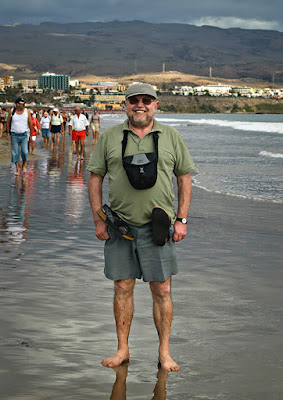
What can I say about these fourteen days of relief from darkness and coldness? Well, it's a repose and a most welcome at that. Even if the weather did not quite live up to expectations. Only four days of sunshine; five days of calima (sandstorm) and five days of rain and cloudiness. Do I complain? Far from it! I am not here to experience eternal sunshine. I am here to EXERCISE, more precisely to get my feet back in shape through walking barefoot on the beach each morning. And this I can do come rain or sunshine! And my toes, curling comfortably as I am writing this, are thanking me for it. By the way, if you want to learn more about this type of home-cooked cure, permit me to refer you back to an older blog of mine, Walking the beach.
Still, walking the beach all morning leaves the afternoon free for other activities. Now and then, I am perusing my laptop to receive the latest scientific advances to cope with the Plague. I am always amazed by the sheer bulk and timeliness of new insights that keep popping up from the scientific wondermen and -women. A recent scientific article from South Africa got my attention. It dealt with a study involving mice (thereof the blog title), since it would be unethical to carry it out with humans. Half of the critters were being vaccinated with Astra Zeneca vaccin (as I recall) injected directly into a vein. The other half got their injections into muscle tissue. The former got side effects in the form of blood clots and capillary leak symptoms, the latter did not get these side effects.
Since it is always delicate to apply results from animal studies to human conditions, I suspect that this study will go the way of many others, that is, into oblivion. Even I would have put it aside, hadn't yet another study rekindled my interest. That one was carried out by a Norwegian scientist, who studied all youths having been vaccinated (against Corona) in Norway and Denmark, respectively. He found out, to his surprise, that there were more than four times as many cases of myocarditis (heart muscle inflammation) following vaccination in Norway than in Denmark! What could explain this difference? The only valid difference the good doctor could find was: the Danish vaccinators aspired prior to vaccination; the Norwegians DID NOT!
I had to look up the term "aspiration" in a medical lexicon. In the context of vaccination it means that you pull out the plunger slightly before administering the vaccine. If the syringe shows some blood, you have inadvertently pushed the needle into a blood vessel and shall withdraw it! If no blood shows, you can go ahead and push the plunger as far as it can go.
I am not a doctor but have several old friends who are. They all assure me that aspiration before vaccination is good standard practice and should always be done. So, why do the Norwegian vaccinators desist from doing it? Come to think of it, NONE OF THE VACCINATORS that gave me my three shots did either! So, why do Swedish vaccinators also desist from doing it?
I leave it to the Swedish Health Authority and the Swedish Health Administrations to address this issue. To me, the whole affair resembles a playback of an old theatre piece, played in reverse. More than a hundred years ago, a young doctor called Semmelweis had to explain to his older colleagues that washing their hands before delivering babies was good standard practice, to prevent serious side effects of delivering. Nowadays, it is the old guard that knows what to do and has to explain to the youngsters that sloppiness in vaccinating can cause harmful side effects in youngsters (and possibly some oldsters).
I rest my case and leave it at a message to all you youngsters in health care:
DO NO HARM; ASPIRATION BEFORE VACCINATION!
Important update (on 19 February 2022):As you can see in the comment below by Franz (an Austrian medical doctor friend), the German Health Authority (the Koch Institut) had hitherto not found the need for aspiration in Corona vaccination. I was a bit surprised by this conclusion, but am now pleased to note that the Institute, in its latest published bulletin of February, has changed its recommendation. From now on, all Corona vaccination is to be carried out with prior aspiration, with special reference to recently published research. I have not seen a similar change in recommendations issued by the Swedish Health Authority. Therefore, I would appeal to my Swedish medical doctor friends to use their influence to get our, as always sloppy, authorities moving and doing the right thing, as the German authorities have done.
And to my other friends: I would advise you to explicitly demand aspiration before vaccination. If the vaccinator would refuse or not understand what this means, it is advisable to use another clinic that is better informed about how to avoid the risks with intramuscular vaccination.
During the past two years, I have touched upon the Plague in no less than ten blog posts. Hopefully, this time will be the last one for me to extemporise around the theme.
Why am I into it again? Well, to judge from recent events in South Africa, and increasingly in our parts of the world, the worst mutation of the Corona virus hitherto is already upon us. It is by far the most infectious, maybe ten times as much as earlier versions of the Plague. It will blaze like prairie fire through the global population and affect virtually everyone in its path. As I am writing this, at least a million persons a week are being infected in the UK, which is a foreboding of things to come in our own countries, even in Sweden here in the North.
As far as can be glimpsed, no one is fully protected against its infection. We may now all get the disease, whether vaccinated or not, whether having been already through the disease or not. It is safest to assume that we have to go through this hand in hand.
Whilst I am writing this, I can not keep from smiling and nurturing a rather rosy view of the year to come. Am I grasping at straws in desperation? Quite the opposite! At long last, the virus has reached a development stage that, with all probability, will lead to a timely ending of the pandemic, turning it into a relatively harmless yearly affliction, easily countered by recurring vaccination.
The reason for my prediction is of course the insight, that the new Corona variant does not affect us already vaccinated (or having gone through the disease) to a large degree. Don’t misunderstand me! People not enjoying the above protection will be as badly hit, when infected, as with the earlier variants. Therefore, the risk for them of getting severely ill or even die from the disease will drastically increase (compared to the earlier waves) in the one to two months to come. But once the wave has abated, most of our populations will have at least some kind of immunity
In that context, permit me to address those of my friends who have chosen to abstain from vaccination. I respect your decision, with the understanding that grown-ups should be free to make their own choices. However, you may wish to take a closer look at the situation and put your affairs in order whilst there is still time, including writing your last will. It is only too easy to fall into the trap of “dependence between taste and belief”, so please stay rational. By this I mean to be aware of the greatly increased risks befalling you within the next two months and act upon that awareness.
The rest of us, a great majority after all, don’t need worry too much about the great wave to roll over us within a month or two. We will most probably be infected, but almost none of us will get seriously ill. The risks involved for us may not be greater than from getting an ordinary flu.
This brings me to the title of this blog post. It refers to some wordings by a German poet that got popular through the melody added to them. The content appears particularly relevant in the present context. Why not experience it in the enclosed video, as being sung at a grand finale. The text is as follows:
Wenn die Not aufs Höchste steigt,
Gott der Herr die Hand uns reicht.
When desperation is at its utmost,
God Almighty will reach out to us.
[things will soon start out improving].
(alternative last line for us atheists)
With this edifying divertissement, all left for me is to wish you, Dear Readers of this blog, on this after all calm and serene last evening of the year,
Even if Sweden has been secularised since some twenty years back, Lutheranism, the former state religion, is still firmly entrenched in its culture. Every spring, when youngsters assemble to celebrate, one tune always reverberates through the air in jubilant buoyancy. Only a few of the jubilants are aware of singing a Lutheran choral, listed as number 199 in the Swedish Church Hymnal and sung in Church ever since 1695. I won’t let you be ignorant of the lyrics, at least the starter:
Den blomstertid nu kommer
med lust och fägring stor.
Nu nalkas ljuva sommar,
då gräs och gröda gror.
Blooming season now arrives
with sheer joy and beauty both.
Lovely Summer soon then follows,
lets the crops and forage thrive.
(Home cooked translation: Emil Ems)
This song resounds with particular timbre this year. Many of us now tend to interpret it figuratively. After a loong winter of troubles, with the plague forcing ever more caution and isolation upon us, suddenly, with the help of technical miracles, we are relieved of this terrible burden and can begin to hope for a more joyous future. Just yesterday, the news told us that one third of our population has already been inoculated at least once. Even if the rate of newly infected is still surprisingly high, the death toll is decreasing and intensive care units are getting a long awaited relief.
As if to underline this new beginning, we have enjoyed an especially bountiful cherry blossom season here in Stockholm this year. Cherry blossoms as far North as Stockholm? Yes, indeed! Although not the original Japanese delights, our cherry trees here are of an especially hardy strain, cultivated to endure Northern climates. But, looking at the flowers, you would not notice a difference to the Japanese originals.
In fact, the Japanese community in Stockholm is pilgrimaging to Hammarby Sjöstad (my part of town) in droves every spring to satisfy their cravings for picnicking under a pink flowery ceiling. We ordinary Stockholmers gladly join in, even if most of us are content with ambulating around the trees and taking pictures.
Photographer as I am, I have lived in Hammarby Sjöstad for twelve years now without ever documenting the pink abundance. But this season is different. A new beginning, so to speak, apt to be feted with plenty pictures. So, without further ado, here it is, a small video showing off my home district at its flowery best, accompanied by the venerable Lutheran choral.
This winter has been a rather peculiar one. It got off to a good start. Most of January and half of February were being blessed with reasonably cool temperatures, hovering moderately below 0° C. With this, a nice cover of glittering snow mirrored a sun never failing to appear in the mornings. As made for nice walks in the proficient neighbourhoods of my home!
Unfortunately, things took a turn for the worse after that, and a loong period of drabness ensued. Day after day laboured on, with grey skies and temperatures varying just around the zero-mark. It was as if a grey blanket of morosity had decided it proper to cover Hammarby Sjöstad.
But why did I find this peculiar? Isn’t this the usual state of affairs in Stockholm, around February/March, before the sun is deciding to make a definite breakthrough to announce the advent of spring? It took me some time to find out why. Finally, I got it. The drabness I experienced was not that of the sky above us, rather usual this time of the year. No, it was the dread I felt within, in my mind as well as in my bones!
Back in January, life seemed to get honky dory again. Didn’t the authorities announce that vaccination of us old-timers was imminent? I already made plans for a quick trip to the Canary Islands in March, lapping sun on the marvellous beach of Playa del Inglés and ambling along, with my toes sunk in the sand. Alas, it wasn’t to be. Week by week, announcements came of the need to postpone the desired relief, and, in lock-step with the grey skies appearing regularly above my head, the mind started to dive into deeper and deeper folds of despair.
Finally, two weeks ago, the long awaited announcement came. Time to register for vaccination at long last! Three days ago, on Easter Monday, it was time for me to get relief. My first shot of the AstraZeneca miracle lotion! Still, nine more weeks to get the second shot. And first two weeks after that will I be fully protected (to 95%, that is) against the current strains of Corona. This brings us to mid June!
Still, who am I to complain. Hitherto it was unheard of that a vaccine could be developed and applied whilst a newly arriving pandemic was still in full swing. We should be amazed at the progress in science that made it possible! Harken, you people who can but complain over the tardiness of vaccination and blame both companies and authorities for undue delay. We got the shots at an unprecedented speed! Time to relax and be content!
Still, even if the period of dread is passed, I feel its after effects. It is as if I suddenly have aged 5 years in the short period of the plague. Isolation and hopelessness have a price. Hopefully, this decay can still be reversed, once I have my trip to the Canaries!
In the mean-time, why not have a go at a nice tune I recently discovered, which seems to mirror my sentiments exactly. But in a much more humorous fashion. Enjoy!
This time of the year we sometimes are subject to a peculiar phenomenon occurring in the Northern regions. It is February and, whilst the morning sky is getting brighter, day by day, the air keeps getting colder and colder. The days are often sunny and dry, but very cold, with temperatures having difficulty to rise from nightly lows of around -15° C. All in all, these are conditions far preferable to the ordinary Stockholm winter, when temperature is alternating between +1° and -1°, with a lot of slush to wade through, and icy spots to break your bones on, whilst taking your daily walk.
The above experience appears to me an apt metaphor for the present Corona malaise. On the one hand, more and more people are getting vaccinated and saved from the Plague; on the other, a recent mutation of the virus, much more aggressive and deadly, is getting closer and closer, having engulfed all of Albion to the West already, washed up on the shores of Ultima Thule and led Svithiod (Sweden) to close its portals to the outside world; in vain, it turns out, since the fiend is harrowing us already from within.
5 February at 8.25 am ...
But back to reality: the other morning, I noticed a peculiar apparition from my breakfast table. On Hammarby Canal, towards its West, a huge ice floe had formed, finely powdered by light snowfall in the night before, and moving slowly but surely Eastward towards Hammarby Sound. The water in the Canal is essentially freshwater, since it is being replenished periodically from Lake Mälar, whenever the large lock between the two is being operated. Thus, it tends to freeze over sooner than in the Sound, which contains mostly brackish water from the Baltic.
... at 8.50 am ...
As I was geting on with breakfast, 25 minutes later, the wandering floe had already entered the Sound ...
... and at 9.00 am
... where, after another ten minutes, the ferry crossing over had to traverse it. With some crunching, the ship was cutting it in half. At the same time, it forced the floe along towards the opposite shore, where it joined the firm ice already hovering there due to freshwater being fed into it from the upper lakes on the plateau.
Only rarely can we witness a complete freeze over of Hammarby Canal; it occurs usually on a calm Sunday morning, when temperatures in the night before have hovered well below -15° and no vessel has yet trafficked the narrows. The picture below was taken five years ago and I was lucky to catch it with just one small boat cutting up the flat surface.
Looking at that picture now, it appears to me as another apt metafor for life in the times of the Plague. Each and one of us has to labour on, in self-isolation, looking forward to reaching the “open waters” of the company of others and social togetherness.
An apt metafor for life in the times of the Plague
Let me take the occasion to deal with yet another facet of living with the Plague as a solitaire. Even if aspiring to be a world citizen and being, admittedly, a Swedish national, I feel drawn back to my place of birth off and on. To me, self-isolation has no great disadvantages in daily life, since I am a loner by nature and live by myself anyhow, even in ordinary times. But, I would age prematurely and certainly have a shorter life span if I were permanently prevented from revisiting my place of origin at least once a year. Last year it proved impossible to go back there, and it may remain impossible this year as well.
So, as consolation, I listen from time to time to a tune that deals with the issue. I admit that many of You Readers will have difficulty understanding the impact of this song. But, rest assured, it means the world to a lot of the German speaking people in Europe (about a hundred million all in all), just as this song means the world to the Swedes. Its refrain goes like this:
I wüll wida ham.
I fül mi do so alan.
Brauch ka grosse Wölld.
I wüll ham noch Firscht'nfölld.
I want to go home again.
I am feeling so lonely here.
Don’t need the world at large.
Just want to go home, to Fürstenfeld.
For most of the about 100 million impacted by the song, the word “Fürstenfeld” just stands for “Heimat”. For me, it stands for exactly what it is. It so happens that the hamlet of Fürstenfeld lies just half an hour on bicycle away from my place of birth. So I trust you understand that this tune means the world to me as well. Enjoy!
No! I am not referring to an ominous party in South America. Neither to a famous climbing path in the mountains of Mexico. Rather, to my daily elations when treading the paths on my morning walking round.
This time of the year, I nurture the habit of going to bed way after midnight. This way, I can convince the body to awaken first around 8.30. when the first light of dawn is tickling my nose. A lazy breakfast later, I am ready to step out into the world, around 9 am, when the sky has definitely lightened, although retaining its blanket of greyness.
Right midway on my morning round, I have to climb a series of steps to gain access to my favourite nature spot: Sjöstaden’s oak grove, the only one remaining within the city limits. You of course remember that I have dealt with it before (see Serendipity), but, passing through it every morning, I cannot keep from mentioning it again.
This time of the year, infallibly, when I pass the giant oak corpse seen above, I am enticed to start meditating. This morning again, my mind began wandering, musing about the effects that solitude has on our psyche, in particular the forced one imposed on us by the plague.
For me, surprisingly, living isolated for a prolonged period of time has the particular effect of retrogradation. This may sound ominous, but really isn’t. Rather, it effects me like being peeled as an onion, or, if you prefer, being bereaved the bark like the tree you see above. In other words, the personality I was born with and which stayed with me when a child, and a bit into adulthood, is now slowly but surely reappearing from the shadows.
Thinking back, I can just about recall that I was a rather solitary youngster, quite content to play by my own and let my imagination be my favourite companion. And what a rich imagination I had! When becoming adult, I started to realise that I was an outsider with this propensity and tried to fit in with people my age. It now dawns on me that this must have taken a lot of effort, which may explain a certain decline in internal life, with its imagination and creativity.
But never fear! It now all comes back to me. And even without giving me a bad conscience for preferring to be alone! It is, as if an enormous weight has been lifted from my shoulders, and imagination now can come to the fore again without being suppressed.
I am glad that the plague came at a propitious time, precisely when I needed that extra boost of imagination. Thanks to it, I was able, this year, to complete fully six chapters of my magnum opus, the Emser Chroicles (see Three Men in a Car ...), a tale spanning more than a thousand years and now, thanks to Corona, already two thirds finished!. Will I be able to untangle the thread fully before the end of next year? I better hurry! Soon vaccination will put an end to solitude and may speedily force me back into my normal and more bland adult personality.
But we are not really there yet! Permit me to enjoy solitude as long as it lasts! Still, whatever the future will bring, we can join hands now and wish each other
It is the first week of November now, and the world appears to be completely held hostage by the drama evolving in various US States. Will they ever again get a democratically elected President over there? Here in the calm North, events evolve with considerably more serenity. Granted, the plague has taken off again, but even this abomination seems to respect the peculiar Swedish way to procrastinate.
Even if hospitalisation is doubling by the week, and deaths are increasing, they do this from very low numbers. This allows the authorities to issue their usual mumblings, including noncommittal advices to us commoners. We oldtimers, on our part, have learnt our lesson and take care not to get too close to the youngsters, who continue with their life as usual.
For us seniors, this prolonged state of self-imposed isolation, which certainly will last well into next spring, is not without its consequences for the psyche. Routine tends to evolve into dread, and dread into depression, if contacts with our fellow humans are being kept at minimum.
Fortunately, there is video-conferencing, which allows us to keep in contact with whomever we wish to share our solitude at the moment. There is an intriguing programme, called Zoom, which has bewildered many an old-timer, but, once reasonably mastered, gives us access again to all our family and friends. Many a birthday song has been sung on Zoom these days, and many a friendly congregation held, wine glass raised, in virtual conviviality.
Despite these virtual activities, social isolation reigns supreme. How deeply does it affect me? I am a bit surprised over my resilience in that regard. But, being a solitaire by nature, the difference to ordinary life is not that large for me. Still, I am missing the daily roundtrips to cafë and restaurant, with their opportunities for short but still well-needed social contacts. So what has come to the rescue in this time of need?
Surprisingly enough, it is a resurge in photographic activity. Surprisingly, since I have thought for some years now that my ability in that regard had faded away, that I had outlived my creative years. But, the mind works in mysterious ways. If laid shallow, through social inactivity, other parts of the brain take charge and force you to adapt.
Come to think of it, renewed photographic vigour should not have come as a surprise to me. Looking back the past fifty years, I have always been active in this art only with short outbursts, interspersed with long years of inactivity. Had I not written about this insight already in my book "Brussels/Stockholm..."? Well, yes, as the citation below bears witness to:
"... one notices that my photographic life has not been marked by continuous activity. Instead, short-term periods of hectic picture taking in great creative bursts have been lodged within long years of inactivity. These short active periods have been linked to times either of great stress, illness or change. This may have reinforced the inclination to produce serene calm in my pictures, as a way to find solace in a hobby removed from the ordinary way of life. The photographic activity in itself may have helped me resolve difficult circumstances in my life, sparing me from seeking help and solace from outsiders."
There you have it! The brain forces through photographic creativity as a way to coping with a time of troubles like the present one. Encouraged by this renewed insight, and asked by a Chinese friend to document Stockholm Autumn for her, I went forth with my camera last week, on a day as made for catching the coloured scenery of autumn.
I did not have to search far for motives. On that very day, "the light was right", as we fellow photographers use to say, and I just ambled along my usual morning trail, pointing the camera hither and thither, never failing to catch a serene scenery.
At about the mid-point of my morning round, I always have the pleasure of entering an embracing and soothing piece of wood, which actually is a marble of nature: the only remaining grove of mature oaks within the city limits of Stockholm! Every time I pass through this enclave, my heart slows down its beatings and calm enters my whole being. This is what it was like to experience nature hereabouts when men's history was just beginning.
When I first saw this sacred place of gnarled and crooked oaks, ten years ago upon my arrival in Sjöstaden, it was still a rather unspoiled piece of nature on a hill, criss crossed by a few nature paths and quite fathomable to the walker.
Since then, already almost half of it is gone! Three new schools and several daycare centres have been built on its fringe and a substantial piece of it cut down and converted into play grounds, with just the odd old crooked witnessing about the site's former glory.
The other half is still standing, "Thank God!", but is now being heavily "attacked" by some serious asphalted hike and cycle paths. I fear the worst for the grove's future, being loved to death as it is, by myriads of small trampling shoes, carrying horde after hord of small children through nature. It will do the children a lot of good to sample creation at its best, but it forebodes the demise of a truly natural habitat. A sign of the times in our age of overpopulation and demise of species!
Back out from the grove, the camera kept clicking away! Almost back home again, another angle at coloured bounty waited to be covered! What a piece of luck that I had my camera with me that day!
Just a week later, when I am writing this, hardly any leave is left on the trees. Neither is coloured bounty covering the grounds, since caterpillars, gasoline spewing blowers and rakes have done away with it with a vengeance.
After all this largesse of colours, I cannot find a better way to finish the blog than to present you with a tune as accoutrement. Let the super smooth voice of the crooner render the rest of the day yet more palatable!