Monday, 7 October 2019

AUTUMN LEAVES


Sometimes it pays off to follow the urges of your subconscious, rather than making up long-term plans that tend to disappoint you in their execution.

Around mid-September, life was starting to become more focused again here in Sjöstaden, since long Summer days were gone and it seemed  – for a short while – as if the flow of days and nights had reached an equilibrium, of a kind especially proficient for getting things done.

Whilst picture taking had been in hiatus for a while, the trigger finger started to itch again and I even took a camera with me on one of these crispy clear Autumn morning hikes. It is amazing that I still manage to "sqeeze out" new perspectives on my closer neighbourhood these days; shouldn't I have gone bored with it after ten years' living in my Sjöstaden? Apparently not, to judge from the two pictures below:


The first one is taken where hikers pass the lock between Lake Sickla and Sickla Canal, which in fact consists of two locks in series. The second lock had to be built since the new road bridge crossing the outlet of Lake Sickla happened to be constructed so low that no boats could pass under it!

The second picture shows the passage under the road bridge connecting the Sickla Peninsula with the main part of Sjöstaden. In the back, you just about can glimpse the red building housing Restaurang Göteborg, the finest eatery in Sjöstaden, located in a romantic fashion along Sickla Canal just below the locks.


Whilst taking these pictures, and generally enjoying life, suddenly, I felt the urge to do something new and surprising, rather than just aching on with my lengthy Emsland blog. Thinking about what could appear new and surprising to a septuagenarian who has seen it all, a name suddenly popped up from the caverns of memory, "HOCHOBIR"! It so happened that I had climbed that mountain in company with my wife exactly 40 years ago; why not try it again and see, whether I still could do it? Said and done. I hastened to book a trip to Austria, taking care to combine this adventure with visits to dear friends and relatives.

One of the later, my younger brother Ludwig, even was so considerate to suggest that he accompany me on the climb. No doubt, he was fearing the worst and wanted to render support, if needed. I gladly accepted his offer and we agreed to meet on 22 September morning in the mountain's vicinity.

The Hochobir is somewhat unique, in that it rises as a solitaire from the South Carinthian Valley of the Roses. It is not especially high, as Austrian mountains are measured; still, it surges a good 1.5 kilometers straight up from the plain. From the top, and on a clear day, one can admire essentially all of Carinthia, from the Karawanken to the South (the border mountains to Slovenia) all the way North to the Grossklockner, Austria's behemoth.

The Rosental (Valley of the Roses) in Southern Carinthia
Photographer: Jörg Schmöe

On this beautiful Sunday morning of 22 September, we drove a winding small road up to an isolated mountain hut, called Eisenkappler Hütte. From there, it was a question of getting our act together and climbing up, slowly and painfully, some 600 meters of altitude to the top of Hochobir. The Guidebook tells us, rather sprightly, that it would only take some 1,5 hours to do so. And, indeed, I recall that my wife Alice and I considered it a nice promenade (I even had sandals on my feet) forty years ago.

But this time was different and rather painful. Slowly putting foot after foot, and not looking too much ahead, I kept going, with grim determination, hoping the torture to end at long last. After two hours' labour we eventually arrived at a wide plateau, called "Kraguljišče" in Slovenian and "Napoleon Wiese" in German. Time to take a well deserved time-out! It had to be short, since the we had planned on a mid-day sandwich luncheon on the very top. Fortunately, we could glimpse the summit already, and it did not seem too far off. So on we went, with renewed vigour.

After another 45 minutes' painful ascent, we arrived at some ruins of a stone mansion, which we learned later were the remains of an old mountain hut, the Rainer Schutzhaus, sadly destroyed in the last battles of WWII. It would have been nice to have a Schnitzel or at least a Lederknödelsuppe at that stage, but destiny had decided otherwise. So we had to trod on. Just minutes later, we glimpsed a large hole in a nearby knoll, which, as brother Ludwig knew to explain, was the remnant of an old lead mine, abandoned already some 100 years ago.


Up to now, I was too exhausted to think about picture taking, but this mine was certainly worthy of being documented, to honour the poor devils who had to toll on this mountain, either hiking up and down every day, or spending the night in the forerunner to the Rainer Schutzhaus (which used to be the miners' cabin), shivering in the thin and cold mountain air.

But now, at long last, the summit beckoned. Soon we arrived at a kind of precarious crossroads, with two paths meeting on a rather narrow ridge leading to the top. Standing there is to be recommended only for those who are steady on their feet – or, at least, have a third leg to lean on. To your left, an abyss opens up, with an unhindered view down into the Rosental.

Proceeding uwards along this ridge we arrived at the summit, at long last. It had taken us almost three hours to get there. Can we conclude from this that I am now only half the man I was forty years ago? As concerns physical capacity, this is certainly the case; but, I refuse to believe that it also applies to my mental capacities. Have I not in these intermittent years managed to complete my PhD thesis, as well as to produce several literary oeuvres, and met numerous intricate challenges in working career that certainly have honed both planning and problem solving propensity? Thus, being only half the physical man may well, as consolation, be compensated by now being twice the man, mentally speaking!

Thus fortified in spirit, Ludwig and I lined up at the summit cross, to document the success of our venture. 


To be frank, Hochobir's summit does not look altogether spectacular, being a small plateau rather than a narrow peak, but don't let looks deceive you! If you dare approach the rim of this small expanse, like the couple with dog in the next picture, an abrupt decline below your feet threatens your equilibrium since, between your shoes and the valley below them, there is nought but thin air for a vertical distance of more than 1.5 kilometers. 
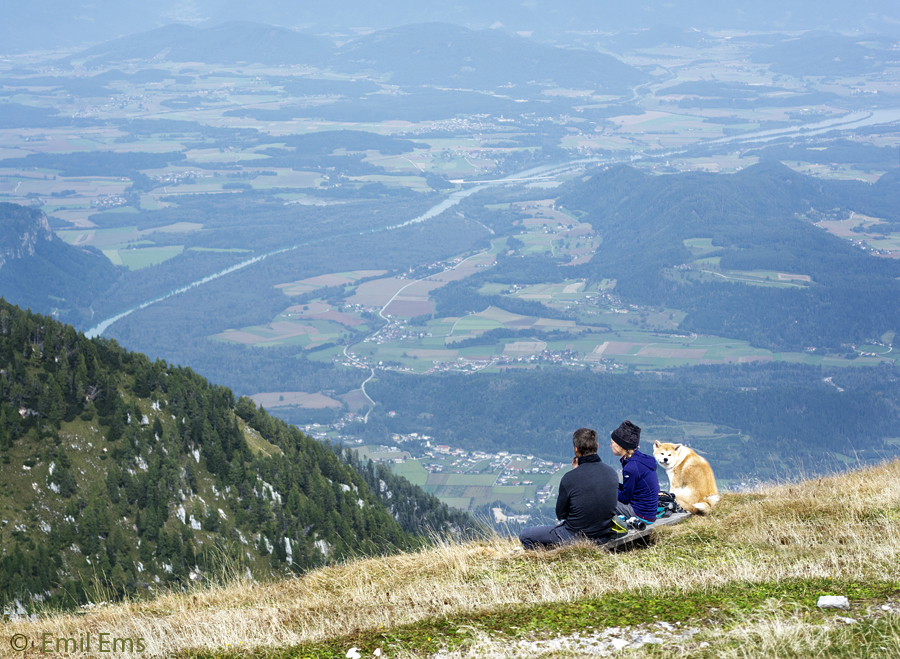

Whilst munching our sandwiches on a sheltered nook at the summit, I started to re-consider my memory of the earlier ascent, forty years ago. How come that I remembered it but vaguely, and as a cosy promenade with sandals on my feet and, furthermore, accompanied by my wife Alice, who was somewhat reticent as concerns mountain climbing? Did we really climb this mountain? 

Upon my return to Stockholm, I revisited my picture collection from the trip of forty years ago. And, low and behold, I found pictures there witnessing our ascent! It may be doubted that we did not go all the way to the top, but rest assured that we made it at least up to the ruins of the Rainer Schutzhaus. From there, it is only a short distance to the summit, so we probably made it. You don't believe it? Well, let me show you some proof. 

View of the Rainer Schutzhaus Ruin ... taken in 2019

... and in 1979

There is an intriguing difference between the two takes. Whereas the 1979 picture shows the tunnel view of an instinct driven youngster, its 2019 counterpart widens the view markedly. To me, the wide angle view in my more recent pictures appears to indicate an increase in readiness to grasp reality in all the range and complexity it possesses. As we can see, the people in the 2019 picture appear like ants in the greater context, which is about how I am perceiving humanity nowadays. 

Yet another set of pictures shows a rare superimposition of my former wife Alice and myself. This time a bit further down the mountain, on the green expanse somewhat funkily called "Napoleon Wiese".

A septuagenarian on "Napoleon Wiese", in 2019 ...

... and his former wife Alice, back in 1979

But let's go back up to the summit for a moment. From up there, as I already said, a marvellous view can be had of the Karawanken Range to the South. The top rim of this cavalcade of summits constitutes the border between Austria and Slovenia. In the old days, there were even Yugoslav guards watching the frontier, which we experienced when trying to climb the "Hochstuhl", the highest summit in the Karawanken. The mountain path up to its top was cris-crossing the border and, unfortunately, we did not have our passports with us on the hike; so no summit was reached that day! 


Whilst looking at the range, I couldn't help noticing the "knoll" in the middle of the picture, which actually is the highest top of the Eastern part of the Karawanken, called "Koschutnik Turm". "Now I remember!" I suddenly felt the urge to shout to Ludwig and some other people standing nearby. "We have been up there in 1979 and my wife almost died trying". And this was indeed the case, so let me tell you the story now. 

It was late August in 1979. We had just come back from a pleasant séjour in Dalmatia and entered Austria via the Loibl Tunnel. Intense greenery welcomed us and the enticing nature of the Rosental invited us to stay for a few days and do some hiking. The first day was dedicated to mount the "Hochstuhl", to no avail due to lack of border documents. On the second day we were lucky to climb the "Hochobir". On the third day we rested or, rather, drove around by car to savour the romantic small valley just below the Karawanken, with Zell Pfarre as its center village. This is when we discovered the Koschutnik Turm, as shown in the picture below.


The Turm did not at all look as formidable as it really was – and as it can be grasped from the top of Hochobir – so even Alice thought it might be nice to hike to its summit. After all, hadn't we successfully ascended the Hochobir the day before? Said and done, early the following day we began what we thought would be a pleasant hike, by driving the car up to the Koschutahaus. From there, about one hour's easy walking brought us to the foot of the Turm, about where the red line is starting to the right in the picture below.


So far so good: another half hour's walk, in increasingly more demanding terrain, brought us to the canyon to the left of the tower. 

Alice rounding the foot of the Koschutnik Turm (see red circle above)

Here, we were supposed to climb steeply upwards, in an increasingly loose steep scree (a rise with very loose gravel), where every two steps upwards slided us one step backwards. Still, we managed to meet this challenge with youthful vigour and arrived eventually at the canyon wall bording the scree on its right, where ascending was easier. 

Unfortunately, after some fifty meters upwards, there was a big red sign asking us to traverse the scree to the other canyon wall. This proved to be a major undertaking. I was crossing first. The scree was now so loose that every step across brought me several meters downwards. After arriving at the left hand wall, I had to climb carefully back up to the hiking path, through rather loose rock. Alice, seeing my travails, categorically refused to follow suit and declared that she would continue upwards on her side of the canyon. So, up we went, with a sea of scree separating us. 

Hikers crossing the scree ahead of me

But, our ascent came to an abrupt end. Whilst I was watching a lonely eagle sailing majestically above us all, a low rumble suddenly vibrated my ears. When I looked to my right, where the rumbling had started, suddenly, a huge stone came tumbling down the crevice, aiming straight at Alice! A call of warning from my side, a glance from Alice's side and, to my extreme surprise, my wife suddenly scrambling up the vertical canyon wall with lightning speed like a mountain goat! And well it was that she did! Since, after some loose gravel following the boulder, a whole avalanche of stones came sailing down from a ledge further up, like a rocky waterfall, just about grazing the heel of Alice's shoes as she continued clambering up the wall. 

After this breathtaking intermezzo, I trust you understand that further mountaineering was off the day's check list. Without further ado, down we went as fast as possible. For me, it was a question of descending with my "Seven Mile Boots", that is, sliding down the scree several meters for every heel I dug into it. My wife, more cautious, applied another method of sliding downwards, as can be seen in the picture. The end effect was the same, but, well back in the valley, I had to buy new hiking boots whereas she had to acquire new jeans! 

Alice's more cautious method of descent

All in all, our short séjour in the Karawanken Range proved a great success. Not only did we manage to climb to the top of one of the three mountains we had put our eyes on; we also came away from it safe and sound, with only some damage to trouser and shoes! So, by now I trust you understand why I had felt the urge to return to this cosy bit of nature forty years after the fact.

-o-

Just now, I am sitting in my writer's studio back home in Sjöstaden, searching for some apt ending sentences to this adventurous blog post. It is a sunny late afternoon, the air is fresh after a recent rain, but I have difficulties in collecting my thoughts. Suddenly, the room is getting very dark, like night had suddenly arrived, but far too early for beginning of October. I am rushing out to the balcony, to see whether this is the end of the world! Not yet, I am relieved to say; instead, a dramatic view is greeting me, as made for a concluding picture. Thus, nature relieves me of the onus to put in some inspired final words into this blog post. After all, who could outcompete heaven at its most dramatic? 

Nature's very own ODE TO LIFE!


Friday, 29 March 2019

A VAINGLORIOUS ATTEMPT AT MASCULINITY?

A skyscraper in Sjöstaden – architects' wet dream – inhabitants' bad dream!

No one living in our cosy little neighbourhood of Sjöstaden (with 25 000 inhabitants, but still cosy) can help notice this "middle finger" being raised at us, whilst we are taking the tram to subway station Gullmarsplan. It is an enigma to me why architects and building companies hunger for raising such an outlier at odd places in Stockholm. This will be the third scraper raised, with at least three more in the pipeline.

I ask you: why on Earth did the city authorities authorise this extreme case of one-up-manship? It is as if largesse in size is equalled to grandeur in style by the town officials. Anything higher than 20 floors goes, if there is but an empty building site allowing for it. Unfortunately, city officials' understanding of urban aesthetics is hardly shared by us poor suffering citizens.

Aesthetics aside; did the town planners think about the logistical nightmare being created by this outsized sugar top? Close to where its feet are planted into the Earth, there lies one single small roundabout, which has to accommodate, on the one hand, all morning and evening traffic flowing to and fro our neighbourhood into town, and, on the other, all the cars coming from Southern Stockholm and choosing to travel to downtown, using the small bridge across. Already without the new scraper and surround, with its forthcoming 6000 working places, this roundabout is hardly navigatable during rush-hours, with huge queues backstopping way into our neighbourhood. Imagine what will happen with the abrupt increase in car traffic created by this new development.


I am sorry to say, that there will be NO ROOM to enlarge the roads around this abomination of a city plan! Every single square meter of the necessary space is already occupied. What were town planners thinking when approving this building project?

You may conceive of me as being a hopeless nostalgic, forever opposing progress. And I am forced to agree, even if my reaction to this unnecessary and molesting skyscraper appears to me more rational than affective. Still, I think it is better to be a nostalgic, wishing to keep hold of all that is pleasant in the city, rather than embrace "progress" that implies getting rid of what is pleasant and replace it with abominations!

An old song comes to mind, which will help me to underpin my position. Unfortunately, it is in Swedish, based on an Italian original. But allow me to reproduce and translate here the core lyrics of the tune:

Lyckliga gatan du finns inte mer,
du har försvunnit med hela kvarter.
Tystnat har leken, tystnat har sången,
högt över marken svävar betongen.
När jag kom åter var allt så förändrat,
trampat och skövlat, fördärvat och skändat.
Skall mellan dessa höga hus en dag, stiga en sång?
Lika förunderlig och skön som den vi hört en gång...


Lucky Street, you exist no more.
You have disappeared with the entire neighbourhood.
The game has ended, the song has subsided.
High above the ground floats the concrete.
When I came back everything was so changed,
trampled and plundered, damaged and desecrated.

Shall between these high risers one day rise a song?
Equally wondrous and beautiful as the one we heard once upon a time...


Will a song rise around the Sjöstaden high riser one day?
I doubt it!


Tuesday, 1 January 2019

FATA SUA QUADRIGAE


This time of the year is usually dedicated to retrospection. Typically, you are looking at the past twelve months, at your achievements in that period, your mistakes and disappointments, and make pious pledges to become a better person the following year.

I will attempt to do more than this. Instead of looking back one year, I will try to have a glimpse at most of two thousand years in the past. A vainglorious task you may well think. You have, of course, a right to think so. But so do I have a right to make the attempt, being as old and (hopefully) wise as I am. In addition to getting on, I am also a born Austrian and as such always eager to tell a good story. So here goes:

Last October, I had the pleasure of exhibiting my Stockholm pictures from the book "Stockholm/Brussels ..." at a vernissage in Vienna. I am glad to say that this met with great interest. Especially glad am I to have seen so many old friends and relatives at the gallery. The picture below shows the "grand opening" with representatives for the Swedish Embassy, the "Österreichisch-Schwedische Gesellschaft" and the gallery, all praising me with nice welcomes.

Opening of vernissage with my Stockholm pictures in Vienna, October 2018

Inspired by this warm welcoming, I took, in turn, care to talk at great length around the pictures on the wall. The one on top of this blog has always been my favourite, so I went into considerable detail extemporising on the provenance of the bronze horse taking centre stage therein. Afterwards, a young lady was clearly inspired by the presentation and bought the picture straight away, being the very first to acquire a fine print at the exhibition. Hopefully, I have now wetted your appetite for the story behind this horse, since I simply can't resist to let it unroll.

To be precise, the horse in the picture was not originally conceived as a solitaire. Even now, there are two such sculptures standing on Blasieholm Square, in the centre of Stockholm. But there should actually be four horses standing, since the original was cast as an antique quadriga, a four-in-hand team drawing a racing chariot. And we are not talking about just any old four-in-hand, it is the only quadriga preserved from antiquity. You don't believe me? Well, you only have to visit St Mark's Basilica in Venice to see it in all its gilded glory!

The Quadriga of Saint Mark.  Source: Wikimedia

But how did this quadriga wind up in Venice? You may be surprised to hear that its origin is lost in the dawn of history. Investigations of the sculpture, looking at the way the eyes had been cast and the gilding applied, led experts to the presumption that it must have been forged around the turn of the second century AD. It is most plausible that it had been ordered by Emperor Septimius Severus, to embellish the top of his Triumphal Arch in Rome, in celebration of his sizeable military achievements.

The gilding method, in particular, points to the emperor. It concerns a cumbersome and costly procedure, with the labourers involved being condemned to painful disease and certain death. Who but an emperor could order such work?

Triumphal Arch of Septimius Severus in Rome. The Quadriga long gone!
Source: Wikimedia

However that may be, the statue would not have remained in Rome for more than a century. In 330 AD, a new Roman Capital was dedicated in the East, called Constantinople after its founder, Emperor Constantine the Great. Constantine put great efforts into getting this new seat of power up to imperial splendour immediately. To that effect, he pilfered sculptures, memorials, prominent obelisques, etc. from all over the Empire to adorn his "Second Rome".

It is therefore plausible that such a prominent sculpture as Septimius Severus' Quadriga would not have remained unmolested on top of Severus' Triumphal Arch. The rebuilt and enlarged Hippodrome in Constantinople had a four-in-hand to show for it on top the Northern facade, with its start boxes. This most probably is Severus' Quadriga.

Restored overview of ancient Constantinople, with the Hippodrome in centre
The quadriga is just about visible on top of the Northern facade.   Artist: Antoine Helbert

The Quadriga throned on the Hippodrome for a whole 900 years! It took a holy cruisade to remove it. To be precise, the Fourth Cruisade got "confused" and plundered, in 1204 AD, Constantinople instead of conquering Jerusalem! The Venetians, led by Doge Enrico Dandolo, participated in the plunder. Dandolo hastened to have the horses dismounted and shipped to Venice as spoils of conquest. There they were put on the facade of Saint Mark's Basilica and are from then on known as "The Horses of Saint Mark".

You may be led to believe that this is the end of the story. Far from it, several events remain to be told. Granted that another 600 years passed by without incident. But, anno 1797 AD, a modern day emperor was in the making. Napoleon had invaded Italy and now occupied Venice. Like a Septimius Severus reborn, he ordered the Quadriga to be moved to Paris, so that it eventually could crown his very own Triumphal Arch on Place Vendôme, known as the "Arc de Triomphe du Carousel".

Military review in front of the Arc de Triomphe du Carousel.
Quadriga on top.  Artiste: Hippolyte Bellangé

But, as we all know, Napoleon's power and glory came to a timely end, about 15 years after this move. Post the Congress of Vienna, Emperor Francis I of Austria, who by then had become sovereign of Venice, ordered the horses to be returned to Saint Mark. And there they have stayed, with the exception of two shorter deviations, an excursion to Rome in WWI and a visit to Padua in WWII.

The Horses of Saint Mark, now residing within the Basilika... 
Source: Erich Lessing

This about ends my New Year's Retrospection; even if somewhat longer than usual, it still contains, at the very beginning, a short glimpse at my main achievement during 2018! But what about my New Year's Resolutions? Well, I am a senior citizen by now and understand the limits of my free will. What I am able to accomplish, I will of course pursue; but no pledges from my part about activities that I am well aware to be unable to carry out. Instead, permit me to put forward some pious wishes for the future. They concern the fruit of my creative labour. By this I mean, especially, the best of my Stockholm pictures.

... and the copies on the front of the Basilica
Photographer: Jürgen Prohaska-Hotze

These pictures lead a life rather more precarious than my two photographic books. The latter are safely preserved in the Swedish Royal Library, as long as that venerable institution will persist. But the fine prints I am producing will depend on the "kindness of strangers". Only if there are people gracious enough to acquire them and hang them on their wall will they have a life of their own. All I myself can do is to gift them the potential to last of up to a century, if well taken care of by their owners.

So let me wish the acquirers of my fine prints, in particular of the "Venetian Horse on Blasieholmstorg", a long and fruitful life so that they can cosset this creative child of mine. Let the print bring them an understanding of the almost two thousand years of history behind it. Let it induce them to hand it over to their children and them to their children, so that it can last the life span given to it by its creator.

In this spirit, I would like to wish all the dear readers of this blog


A very Happy New Year!


Tuesday, 14 August 2018

DANCE ME TO THE END OF LOVE ...


Last blog post was about a Siberian High, causing Hammarby Sound to freeze over. This seems like a world apart today. The past month proved to be the hottest hereabouts in recorded history (dating back to the mid 1700s). If 35° weren't enough, humidity went to the extreme, envelopping us in a wet blanket day and night and leaving us no place to escape. Our apartments here in Stockholm are built with generous windows, granting the sun free access to us sun-loving Northerners. It now dawns on us that sun-flooded rooms are not what the doctor ordered. Even if my apartment is facing north, the sun starts sneaking in around 6 pm, getting up the heat just in time to prevent me from having a healty sleep.

Extreme times crave desperate measures. I discovered that a daily visit to the neighbourhood (Swedish style) Sauna was the way out of misery. After sitting about 10 minutes in it, sweating out at 90° (Celsius) of dry heat and taking a cold shower afterwards, 35° outside heat appears almost normal!

In the same spirit, I decided, in the beginning of last week, to take a quick trip to Southern Turkey. There, temperature surpassed even 40° in daytime and humidity was at its outmost; just like in a Sauna, but a Finnish one. The idea was to spend three days there and return to a more moderate Stockholm, cooler by at least a few degrees. Now, that I am back, I am glad to say that Hammarby Sjöstad has cooled off considerably during my absence. Or is it the contrast to Lykia in Turkey that makes me believe that?


The recent heat wave got me to recognosce up-to-date findings about climate change. Not bothering with reading the most recent articles in scientific journals, I contented myself with gathering insights from Youtube videos in the field. Don't ridicule me! There is quite serious knowledge to be gained there. As an example, let me point to a recent lecture by Professor Wadhams of Cambridge University. He is a convivial enough fellow, hardly prone to exaggerate.


My research, albeit sporadic, leads me to conclude that we already seem to have passed "the point of no return". Even if we drastically diminish carbon dioxide emissions forthwith, we will still surpass the red line (the 2° temperature increase) early on in the next decade. Thereafter, and with sizable methane emissions from the Arctic continental shelf and from melting Siberian permafrost, climate change will accelerate and lead to a more than 3° increase within the following decades.

An increase by more than 3° may not sound a lot, but it will most probably put an end to the main conduit of global food production, the grain belt girdling the northern hemisphere; not to speak of rendering the subtropical regions, Southern Europe among them, into deserts. So the writing is on the wall.


Interestingly enough, Scandinavia, as well as Great Britain, Ireland and Iceland, may not be exposed  to the same degree of heating as the world at large. The global deep sea current transporting warm water north-eastward is already getting weaker and will no longer lend support to the Gulf stream (which is mostly driven by wind), thus counteracting to some degree the overall heating up.

Should we find comfort in this? I fear not! Think about the hundreds of millions living south and east of our borders and getting ever more desperate, as deserts spread in Africa and Southern Europe and food supply is drying up further north. The Völkerwanderung of the 5th to 7th century AD is just an inkling of what lies ahead of us! To get an idea of what this means, look no further than to the failed states in the Middle East and the millions from there streaming into Europe just two years ago!

What can be done about this? On a global scene, probably nothing. That is, unless geo-engineering at hitherto unexperienced scale could be enacted within the near future, which is hardly likely, if even feasible. Better to look at it from a personal angle. Here we have a problem: climate change is not happening in a linear fashion. Feed-back loops are pushing to the forefront and will greatly accelerate the change, even if we at present still appear to experience only a modest and gradual warming. This makes it difficult for us humans to grasp the high probability of a timely demise of civilisation.

To fix ideas: imagine that a meteorite will strike the Earth in thirty years' time, enveloping the Earth in huge dust clouds and rendering food production infeasible over all of Earth for a number of years, except in north-eastern Europe. How would you as a person prepare for such a catastrophe? Speaking as an old-timer, my life would go on as usual, with maybe a bit more propensity to nurture friendships and family relations. For our children, they will have to be more philosophical; we all have to die, sooner or later, and it may just be a bit sooner for them. It is the grandchildren whom we should pity. They will be in the prime of their life and, instead of fulfilling all their dreams of family and career, they will be in constant war and struggle to fend off the hungering hordes invading the few territories where food can still be obtained.

This leads me to suggest a collective action that still could be taken to make life a bit more bearable for those poor grandchildren. Why not re-introduce comprehensive conscription for all 18 year olds, boys and girls, starting a decade from now. Why not borrow experts from the Israeli army to help introduce an efficient training programme involving weapon use, martial arts combat and living off the land. With an intensive training of this kind, we will at least provide these poor youngsters with a minimum of crafts to cope with the coming catastrophe! This quite apart from maintaining the regular army, manned by professional experts, as is the case at present.

Am I an extremist? Probably so, but I think that I will be considered a moderate ten years from now, when the red line of 2° warming will have been crossed and warming will accelerate. A pity that I probably won't be around then to feel righteous about it! Instead, why not enjoy the good life as long as it lasts, and let art and music come to the rescue, when my thoughts risk becoming too dire.


Wednesday, 28 February 2018

IS THIS SIBERIA?

Freeze-over at 6.55 am on 25 February

The above view is a very rare one indeed! Why do I say this? Well, you can expect to see it only about once in every four years. Several rare events have to coincide to result in this outcome. First, temperature the day before should not be much lower than 0° C, to prevent partial freezing over of Hammarby Canal. Second, there must be a sudden and large drop in temperature after midnight (after the last boat has passed the canal). Third, this drop of temperature has to be accompanied by a slight snowfall. Third, the snowfall must stop before dawn. And, fourth, I must have the good luck of looking out of my kitchen window just slightly before 7 am this time of the year, when dawn is already in motion, and before any ship has passed or crossed the canal.

Temperature not much lower than 0°C, the day before

Last week was a heavy one for me. On Monday, I had a jaw operation, which is preventing me from eating solid food until the stitches are taken out (will be tomorrow). As a result, I am living at the moment with a diet of cottage cheese, soup and yoghurt. This has a surprising effect on my contours, since I have lost more than 5 kilos in weight already. But it also somehow dampens vitality, with the body attempting to heal the wounds and coping with being sustained only by fluids at the same time. 

On top of that, I also caught the flu. This actually dampened my longing for fast food, but compounded the loss of vigour and caused my sleep to be troubled, short and interrupted. So it happened that I was driven out of bed already a bit after 6 am on Sunday last. A pity, since it was still dark and I had to turn on all the lights in the apartment to enliven spirit. But, gradually, as I was preparing breakfast [making coffee and opening a can of cottage cheese ;–)], dark changed to dawn and I started to glimpse a first rosy shimmer above Hammarby Sound. My kitchen table is located smack opposite, so I could watch it through the window without having to put my nose out into the cold.

And what a view it was! Silence supreme was reigning over Hammarby Sjöstad, not a sound, not even with a window slightly ajar. The lake surface looked like a newly painted hospital floor, white and even and, above it all, the perfect trimming of a rosy dusk.  

7.00 am. The first ferry disturbing peace and view

Alas, serenity did not last. As I was surpling my Nespresso, and the hour advancing versus sevenish, suddenly, the first ferry started up on the Southern Island and started its traverse towards our side of the Sound. This was no silent process, I can tell you! The vessel had to labour hard to get going! And the sound, the sound! Like a giant cracking giant hazlenuts! On and on the boat laboured, first forward a meter or two, then backward again to push off and get going again. Eventually, after 15 minutes hard work it reached the opposite berth, a traverse that usually takes only about four minutes.

This Sunday was special for yet another reason. The sun kept shining until early afternoon, a rare sight indeed in Stockholm winter time. Under a blue sky, and as the day progressed, large ship after large ship passed Hammarby Kanal in their voyage from the Baltic to Lake Mälar or vice versa, breaking up the ice and providing me with yet another view, this time smack below my balcony, and  far more common than the view shown in the head picture.

4 pm, large boats having broken the ice during the day.

How does Siberia come into the story, you may well ask. Very simple, our part of the world is at present subject to strong North Eastern currents, stemming from a high pressure zone hovering around Northern Siberia. They cause exceptionally cold air to stream over the still warm waters of the Baltic Sea, sucking up moisture as they go and unloading it in the form of very cold snow on us poor Stockholmers. Ever since last Sunday, each morning is greeting me with the picture you can see below.

Getting to my usual breakfast haunt, for a cup of coffee and a newspaper, means bulking up, wading through decimeter high snow drifts (plowing on my street is starting first later in the day) and being blasted by a storm of sharp icycles. How will this all end, I ask you! Will climate change bring consolation? I fear not! Whilst the continent down South will getting warmer, the Gulf Stream, a giant pumping action from the Gulf of Mexico to the Arctic, and warming Scandinavia (not to forget Iceland and Greenland), will surely start to subside, changing our climate up here to become more like that of Alaska (Stockholm is at the same latitude as Kodiak after all!). So I fear that we have to see this Siberian interlude as a first sign of things to come. God help us!

Every morning the same; blizzard after blizzard!


Sunday, 31 December 2017

IN DULCI JUBILO–O–OH!


This time of the year darkness prevails during most of the day. Difficult to decide when to get out of bed, since daylight chooses to appear first around 9 am, and that only hesitantly. The other day, I managed to rise a bit early, fumbling around in the dark before turning on all the lights in the apartment to jump start my sleep-drunken mind. During the holiday season, my favorit breakfast haunt stays closed, so I was sitting at my kitchen table, sipping coffee and hoping for Hammarby Sound to emerge from its sombreness. 

Suddenly, a ferry emerged, like an apparition, to commence its round-trip on the sound. Out with the camera and, "Clapunck!", the view was preserved for your contemplation. The boat shined like an apparition in the general gloominess and its delicate luminance got me thinking about a carol that we used to sing in our high school choir around this time of the year. In fact, it is the only song I remember from singing at school. The reason being, I believe, that the verses are half Latin, half German, which must have impressed me greatly in those days.


Hearing this song, you would not have guessed that it is more than 700 years old. But it has its roots in the Gregorian Lithurgy, the singsong that can still be heard in catholic masses, at least in the more festive ones. In early middle age, the officiating clergy must have tired of these, let's face it, monotone recitals and tried to embellish them with more melodious outbursts, called Tropi. The song "In dulci jubilo" is a macaronic tropus, with text in alternating Latin and German phrases. 

In dulci jubilo,
nun singet und seid froh!
Unsers Herzens Wonne
leit in præsepio
und leuchtet als die Sonne
matris in gremio.
Alpha es et O.

When hearing it performed, it strikes you that it sounds jubilant, indeed. You almost can feel the energy released, when allowing oneself to get rid of the traditional bonds of endless recitals and start singing a melodious song at long last. I am almost tempted to call it the true "Ode 'An die Freude' ".

In this spirit, permit me to finish this post by addressing you all, my faithful and patient readers, with


My very best wishes for Year 2018  


'


Thursday, 2 November 2017

FEUILLES MORTES

Street lock on Hammarby Quay

Our brain sometimes can play peculiar tricks on us. The other day, when taking my usual 45 minutes' walk after breakfast, suddenly some phrases bubbled to the surface, as if trying to accompany the wind blowing around nose and ears from Hammarby Lake. Let's see if you can recognise them.

"Les feuilles mortes se ramassent à la pelle.
Tu vois, je n'ai pas oublié...
Les feuilles mortes se ramassent à la pelle,
Les souvenirs et les regrets aussi.
Et le vent du nord les emporte
Dans la nuit froide de l'oubli.
Tu vois, je n'ai pas oublié
La chanson que tu me chantais." 
(Jacques Prévert: "Les feuilles mortes").

"Feuilles mortes" at Luma Park

These melancholic words accompanied me on my continued walk, adding to my appreciation of the late autumn atmosphere all around me. Eventually I arrived at the mid-point of my venture, where two giant oaks welcomed me as usual, but, unusually, one was still full of leaves, the other completely bare. A third should have completed the scene, but only its trunk was left, the crown torn down by an earlier autumn storm. 

At mid-point of my daily walk

As I went on with my training round, the sun came out of the clouds and temperature rose appreciably. It was as if autumn yearned to turn into summer again. Even the mallards seemed to enjoy the mellow atmosphere, paddling contentedly among the reeds along Sickla Quay.

Ducks among the reeds along Sickla Quay

I hate to admit that I am a bit in arrear with my blogging. A series of engagements, the foremost a great wedding party in Austria, have kept me from my favourite pastime. This is a pity, since this autumn provided us with many interesting events, at least as concerns the weather. In early October it looked like we would have an early winter again, with temperatures early on tending down to zero degrees (Celsius). Then again, days were back to warming up. Then came a period, still with us, with every-second-day weather, bringing alternately warm and cold temperatures. 

As a result, there are still trees keeping their leaves, even if they have started withering with a vengeance lately. On the day when the above pictures were taken it felt like summer would come back any time. Compare this to last year, when there was a three days' blizzard, preventing me from leaving the apartment, since snow kept accumulating on the streets. 


A rather peculiar event occurred back in October, meriting a blog of its own, which I am sorry to have missed out on. I usually wake up when traffic starts getting heard, and it was already light when I got out of bed around 6.30. Since my breakfast haunt opens up first at 7.30, I could doddle around in the apartment for an hour before getting out into fresh air. Judge of my surprise: it had gotten dark again, as if day had decided to take a sudden turn into night. The sky was dark as soot and I could hardly see my feet moving on the sidewalk. "Götterdämmerung" is the appropriate word for this event. 

People around me were shaking their heads, barely discernible in the dark, and nobody could find a good explanation for this sudden somberness. Day after, the newspapers told the story. A strong southern jet stream had brought sand from the Sahara, mingled with soot from the many fires raging around the Mediterranean. A sign of Earth' future if any. 

But we are spared the travails of Earth warming up here in the North. After an hour or so, the sun managed to break through the massive wall of darkness. Rays of light, clean and polarised, as if from a search-light, brightened the scenery opposite my balcony. Whilst the continent will begin to suffer from climate warming, it will indeed become more agreeable up here!

Sofia Church after "Götterdämmerung"

Being eager to bring this blog to its well-deserved conclusion, I almost forget that there is another autumn day to remember. I sorely missed the 25 years' jubilee on 24 September, of the Great Crisis Nadir of 1992. For those not familiar with Swedish history, or those who have suppressed the sad event, let me freshen up your memory by citing myself from a report I once wrote about it.

"On a sunny day in late September 1992 (24 September) I arrived at the office early, to work on an article on capital adequacy in banking. I did not get a chance to do any work that day, however. The phone started ringing as soon as I entered my room (at 7 AM) and did not stop during the day. The calls came all from foreign bankers and financial experts/journalists and were all about the same theme: How solid is the position of the Swedish Banks, Mr. Ems, how long can they hold out in the onslaught of credit problems and exchange risks. Being a Central Banker I could do little else than utter vaguely encouraging mumblings. But the frequency and intensity of calls indicated that the end was near for interbank lending to Swedish Banks. Fair enough, the same afternoon, Government held an urgent press conference, telling the world that it felt obliged to guarantee all of Swedish Banks' liabilities and that it would undertake a general scheme for bank support to counter the on-going banking crisis. This was without comparison the most demanding and challenging day of my life – it was the nadir of the Swedish financial crisis."

The world has gone on since then, and even experienced a comparable crisis on a global scale 15 years later. We are still suffering from its aftermath. This brings me to the question, whether there could be a repeat of such a sad event in near future. The question is far from futile, since both the BIS and IMF both have recently been making noises about the great indebtedness of nations. Sweden is no slouch in this respect and asset prices have been rising steeply the past few years, a sure sign of a financial crisis being imminent. In my mind, I can see some similarity between the year of 1991 (the build-up year of the great crisis) and the present year.

Most notably, real estate prices have ceased rising and are on a downward trend. Minor building companies are already in difficulty and some even under receivership. So, keep your fingers crossed, lest we will be sliding into bad times. Let's all join in an incantation to be repeated over and over again: "This time is different! ... This time is different! ... This time is different! ... ... ..."

Best not to think about such sad things. Let's get back to where we started and invite a famous French singer to phrase the poem mentioned at the beginning of this blog!