Saturday, 18 June 2016

ALPENGLOW AT 10 PM?


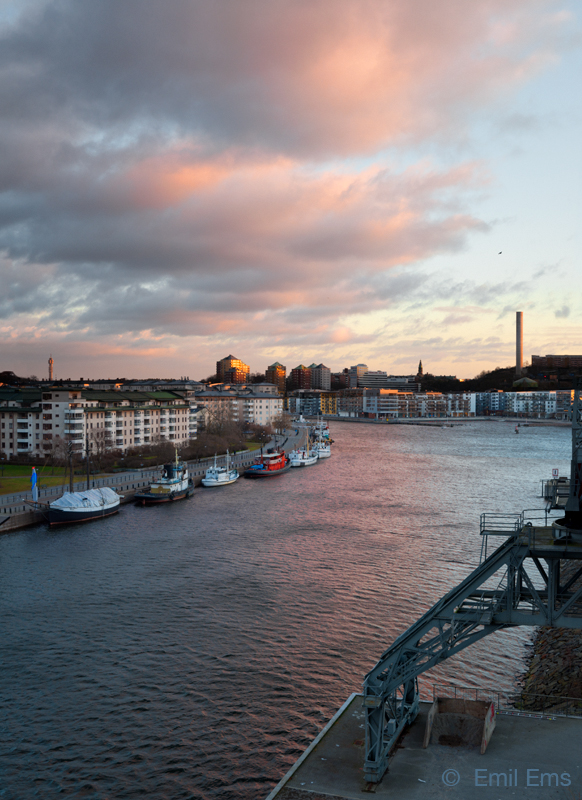
Yesterday evening I witnessed a peculiar spectacle, which I hasten to share with you, dear readers! Around 9.45 pm, when returning from the movies, I took the subway instead of walking home as usual. And I am glad I did. When the train passed the high bridge at Skanstull, where you get a marvelous view of Lake Mälar on the one side and Hammarby Sound on the other, the sky provided an eye opener instead.

It was unusually dark for June, since the sky was overlaid with dark brownish clouds, which completely covered the evening sun. But in a strange way, the sun must have fought its way through indirectly, like using the clouds as a mirror. Over Hammarby Sound towards the East, an unusual rainbow suddenly jumped out of the dark, but only intermittently, partitioned as it was by heavy brown laces. I had no camera with me, so you have to take my words for this. Whilst the train continued its journey, it seemed to creep at snail pace, so full of longing was I to get home immediately and catch this miracle of nature on film.

Unfortunately, the rainbow was long gone, when I arrived at home, 10 minutes later. Instead, the hitherto dark clouds towards the East started to glow, like embers of coal left in the oven after the evening fire. It almost looked as if sunrise would be imminent, even if I knew that the sun was actually setting on the opposite side of the horizon. 

Once again I was lucky to witness an Alpenglow over Hammarby Sound. It was not the first time (see earlier blog post), but never had I observed this phenomenon as late as 10.15 in the evening! To show you the difference between Alpenglow and a sunset lit horizon, have a look at the picture below. This was also taken around 10.15 PM, but in the North Western direction, instead of the direction clear East for the title picture. The date was 6 June. Just a week later, I could observe the sun itself, shining like a low spotlight through the trees just to the left of Katarina church, the dome of which is peeping up over the horizon. 


Whilst I was busy documenting this sunset for you readers, a glad "Hellow" was heard from the balcony opposite mine. The distance between houses here in Hammarby Sjöstad is rather small, so we can easily chat from outpost to outpost. The family you can see here is following my blog with interest and always are complimenting me for it. Thank you kindly, dear neighbors! This time they wanted their own picture taken, which I was happy to oblige. If you click on the first of these photos, you get it enlarged. Moving quickly to the next one, the family will come alive, to delight your juvenile side – I hope – as well as mine. Enjoy!


Tuesday, 31 May 2016

KITCHENHENGE

"Manhattanhenge", Source: New York Times


Just a few minutes ago, I got a very nice e-mail from a friend who is a New York resident half of the year and lives in Stockholm the other half. The e-mail included a reference to an intriguing article in the New York Times. It so happens that on two days, twice a year, the sun is setting along the west-facing streets of the Big Apple. Sunday and yesterday were two of those days, causing hordes of photographers to congregate, tripod and camera in full swing, to capture this wonder of nature  – and spare some time to contemplate the passage of the ages, I hope.

In olden times, there was the habit of building stone circles to the same effect: Stonehenge comes to mind. In Sweden we have a much disputed counterpart, called Ales stenar. It is an impressive build-up of huge stones that the official state authorities claim to be a burial site, of some 1550 years of age. However, an independent researcher has a more intriguing claim: it was a temple dedicated to the sun-cult, with two of the some 50 huge stones of the circle placed exactly at summer and winter solstice. Furthermore, there is carbon dated evidence that this temple of the sun could be much older, 5000 years or more, which would place it in the same league as Stonehenge.

I am an agnostic, but feel nonetheless the urge now and then to worship the sun, photographically speaking. In this context it is unfortunate that my kitchen window, which forms the basis for photographic excesses on this blog, is facing due North. So no splendid counterparts to the title picture can be taken by me for you to admire. But wait! I have lived for more than seventy years already, and have more kitchen windows to show for! In particular, I am thinking about my splendid Brussels apartment with a view, from which I could produce sunset pictures from January to December.

I could produce sunset pictures alright, but mostly in theory only, since Brussels is the "Cloudy City", preventing photographers from taking such trophy pictures most of the time. This irked me, because there was one view from my apartment that I much admired, and where I longed to place a setting sun. I had made exact triangulations and knew, that 18 October (or the corresponding date in March) was the day to plan for.

Could you believe that it took me five years of bi-annual stand-by until I finally got a sunset where I wanted it to glow? During those years, I could experience clouds, light rain, heavy rain, even snow, but never a sunset. Finally, after long and patient waiting, there it was, and ready I was, with my big Toyota Field Camera on tripod, to get it on film. Please take a minute to contemplate the outcome. It took me five years to accomplish it!

"Brusselshenge". View from my kitchen window at Ave Gabriel Emile Lebon
on 18 october 2004


Saturday, 21 May 2016

YOUNG VIRGINS' SUMMER

A nice interlude to my morning walk

I have the habit of taking an extended walk (of about 45 minutes) every day after breakfast. Over the years, the track has been well beaten and I ramble around it almost without thinking. But, without fail, I surface from meditations at exactly one place every morning. There is a reason for it, since that is the only spot where I am greeted by a luscious grove of oak trees.

Although seeing the site in question should be a routine experience by now, two weeks ago I just had to stop and spend some minutes taking it all in. It was around 9 am, and the sun illuminated the landscape with its beneficial glow. And "glow" is the right word to describe also the scene itself. It almost jumped at me with its glorious shining. There was something special with the leaves having started to bud just the day before and I just had to immerse myself in their virginal freshness. 

A propos "virginal", this word reminds me of the very unusual month of May we are experiencing this year (On the other hand, isn't every month unusual nowadays, in this age of climate change?). Although the month started out with icy snow patches still covering our ski slope ("Yes! There is a slalom skiing facility just around the corner from where I live. We even had a Ski World Cup competition here February last), just a week later meteorologists declared that Summer had arrived in Stockholm (defined as a daily average temperature of more than 10°C). This put a lot of pressure on the vegetation to come forward with full speed. As a result, cherry blossoms appeared suddenly, adorning the squares in Sjöstaden, and tree leaves started to bud with a vengeance. 

There is no word in the Swedish language for such an early start of Summer, so I had to invent it for you. Inspiration came from the scenery I witnessed that morning, as well as from the German word for late Summer. They don't call it Indian Summer over here, for obvious reasons, the German word is "Altweibersommer" (Old Spinsters' Summer). So what better term for early Summer than "Jungfrauensommer" (Young Virgins' Summer). Thereof the title of this blog post. 

Fortunately I had a camera with me on that glorious morning. But it proved difficult to get the full scenery on screen. The title picture shows the full extent of the site I could take in with the lens on its widest setting. Still, this was a "tunnel view", far from the scene that had caused me to stop! The eye tends to rove and construct a much more encompassing view than can be caught with a fixed lens on camera. So I decided to construct a full panorama of the scene, as the eyes are roving, only possible to do on the fly with a digital camera. You may be surprised to learn, dear readers, that this panorama is the result of taking EIGHT pictures, and merging them together to obtain the full extent of my experience. You could not take it all in with just a glance, you would have to rove the scene with your eyes, but here it is, the full glory of my morning welcome. 

View of Hammarby Fabriksväg in direction of Sickla Lock

Invigorated by this photographic excess, I decided to repeat it on my way back home along the quays. When I arrived at the ferry boat quay, the boat coming from Central Stockholm was just about to dock. Rushing to a nice viewpoint, I quickly fired off eight shots again with my camera and put them together to get this wide panorama of Hammarby Bay.

Norra Hammarbyhamnen and Hammarby Bay seen from Luma Quay.

I apologize for the technical angle to this bucolic blog, but hope that the pictures can be judged on their own merit, irrespective of how they have been produced.

To finish the post in a more romantic timbre, why not listen to this song by a promising lady, singing about her time as "young virgin". I am sure that "young" is an appropriate caption for her, but am a bit unsure about the second term, considering her emphatic embracing of female lusciousness!

Wednesday, 4 May 2016

VERONIKA, DER LENZ IST DA!

Hammarby Canal at 5 am

I think I have mentioned this before: I have the habit of sleeping with a window slightly ajar, which does me a lot of good and provides for firm sleeping. Unless, of course, there is sudden noise in the middle of the night, which will get me wide awake.

This week, I was rather confident in expecting nightly serenity along Hammarby Canal. This was Ascension week after all, and most people had left town for a prolonged weekend. But to my surprise, heavy ruckus forced me out of bed this morning at the ungodly hour of 5 am! It sounded like a fire engine approaching with all alarms going at full blast. Thereafter, there was consistent noise as if a diesel-fired compressor was being put to good use.

Emptying the septic tank early in the morning

When I stumbled out on the balcony, still half-asleep, a beautiful morning scenery welcomed me, looking towards the west. The sun had risen just maybe 15 minutes earlier, but already managed to bath the quays in warm morning glow. But what about the ruckus? The above picture shows the source of it all. Apparently, the owner of the boat berching across the canal from my balcony had engaged a company to empty the vessel's septic tank! They thought nothing of doing the necessary at five in the morning!

Better rush away, lest people complain

The noise went on without relapse for a good 15 minutes. Thereafter, the lorry left in a hurry, as if afraid of being assaulted by angry residents. Well, they should have thought about this earlier. Considering the fact that a body of water, like Hammarby Canal, is bouncing sound waves upwards and around, residents in almost 500 apartments must have been disturbed in their well-deserved morning slumber by this sudden urge of house-cleaning. 

After stamping around in my apartment for a while, mightily enraged by this unthoughtful intrusion, I managed to calm down again and nourish my mind with positive thoughts. Hadn't this noise induced me to get up unusually early, and provided me with a nice morning view, to share with my readers? Furthermore, should I not consider this irresponsible intrusion as a sign that spring had arrived at long last?

Nobody in his right mind would order the emptying of a septic tank during an icy cold winter night at 5 am. It takes the mellow mornings of spring and summer to awaken the usually sedate Swede to untoward excesses. This ruckus was just the first sign of the "Summer Swede", changing into a Mediterranean "Happy-go-lucky" from having been a responsible Northener, whilst exiting his hibernation in glad anticipation of warmer tides ahead.  

Water valve cover on Hammarby Quay

I have to admit that even I, myself, am affected by this climatic influence on personality. Why not give in to the happy mood of spring and celebrate the arrival of warmer tides with a song that captures the fullness of the experience? I am thinking of a song group that could keep your spirits sprightly even in cold winter times, not to speak of welcoming the warmer season ahead. Like spring, these singers arrived with a flourish, but flourished only for a short while. The evil regime of the 'thirties put an abrupt end to it. But they live on for evermore in their songs, to delight generation after generation of listeners! Here we can enjoy a contemporary version of this famous ensemble.


Wednesday, 30 December 2015

HOW TO COPE WITH LOONG WINTER NIGHTS

Christmas day morning at 9 am.

I have said it before, so no need to repeat myself, winter nights are loong and dark up here in the North. This creates havoc in the brain which needs light to get active in the morning. So what to do, when it is still pitch dark at 7.30, my preferred getting up time over the year?

After many decades of confusion, I have at long last found the answer to this question. You simply have to stay awake a wee bit into the morning hours. If you manage to keep going (by reading, watching TV or working) until, say, 2 am, this will give you a sound 7 hours' sleep until 9 am, when the first rays of the sun will tickle your nose and lure you out of bed.

On Christmas morning, I had pinpointed it correctly. When I rose and stumbled out on the balcony, still half asleep, the very first sun rays already tickled the high risers across Hammarby Sound; the title picture bears witness. It was 9.13 am and time to start a new day.

In contrast, I was up far too early three days later. An eery silvery light shone through the drapes and made my sleepy brain wonder what the world was up to now. This had to be investigated, my subconscious told me, and my conscious self obliged by sliding out of bed and get going.

Hammarby Sound at 8 am three days after Christmas.

It was quite cold out there on the balcony, and I was shivering mightily in my thin pajamas. The reason was obvious. During the night, temperatures had fallen considerably and snow was covering the quays like a white blanket. Real winter had arrived at long last after sensationally warm Christmas weather. Only a few days earlier, on winter solstice day, day time temperature was higher than on Summer Solcstice day in late June!

I first thought that it was the snow who caused the silvery shine reigning over quay and water. But that was not the only reason. After admiring the views eastward for a while, I eventually turned westward and saw, to my big surprise, a full moon hovering over the canal in that direction.

Full moon over Hammarby Canal at 8 am.

Now, I have lived in my apartment for 7 years already, but never before have I witnessed a full winter moon early in the morning. "Thank you!", brain, for noticing the silvery shine and getting me out of bed early to savor its splendor! Isn't it wonderful to make such new experiences at an advanced age?

Having said that, time to look ahead. New Years Eve is upon us! Since I will be otherwise engaged at the right time, I take this premature occasion to wish you, my hardy and patient readers

A Very Happy New Year! 
May all your good wishes come true!


Stockholm in Winter 2010. Building site for railway tunnel in the foreground.

Sunday, 13 December 2015

A "SAINT" IN SWEDEN?

Early Winter afternoon on Hammarby Sound

The scenery outside my apartment should by now be well known to you. I am almost getting blasé about it myself, but this view captivated me. I took the picture a week ago; I felt that it embodied the "loong farewell" of a dying year. 

The last few months have been busy, leaving me scant time to please you with pictures from my balcony. You probably have noticed, from e-mails, Facebook, Google+ and otherwise, that the grand task during this time was to introduce my new book "Stockholm/Brussels". Wide did I range to accomplish this: from the golden hills of California to the much greener ones in south-eastern Austria; and from there to the autumn cold of Brussels. Finally, news of the book reached Stockholm, where I held a "vernissage" cum book presentation last month.

Book signing at the Stockholm event (Photographer: Andreas Cars)

But the end of the year is approaching, as the title picture tells us; time to get in contact with you again, my patient readers! Today's theme is light, or rather, the lack of it in this region far to the North, as far as Kodiak in Alaska in fact. Throughout the centuries, people living here have nurtured a feeling of loss and depression as the sun keeps gradually disappearing in December, feelings that have to be countered and subdued with all kinds of ritual and ceremony.

Sofia Church on 18 November at 3.15 pm

For you Southerners, who may have difficulties understanding our concerns, I think a picture (or two) can tell it better than a thousand words. The above picture shows you the last rays of the sun caressing Sofia Church above Hammarby Sound at 3.15 pm on 18 November, some years ago. So far so good, there was still warm light to savour in mid-afternoon. Even the sky around the church on top of the hill remained illuminated by the dying sun, as the picture is bearing witness.

Now take a look at the same church about a month later and at around the same time in the afternoon; depressing, isn't it?

Ibid about a month later at 3.20 pm

How to cope with this depressing darkness? The early Christian Church knew what it was doing when placing the birth of Christ at Winter Solstice. By partly supplanting, partly incorporating heathen rites it promised the Northern population that light would be reborn, since this was foreboded, so to speak, in the birth of our Creator. But heathen rites have a tendency to linger on, under the thin veneer of Christianity. For instance, in Sweden, Xmas gifts are not brought by Child Jesus or the three Holy Magi, as in Catholic countries; instead, Yule Goat is by tradition placed under the Christmas Tree as bearer of the gifts. Some towns in Sweden, as for instance, Gävle, even place a gigantic straw Yule Goat on their main square at Christmas Time, to be set on fire by ignominious youth before New Year.

  A newly raised Julbock in Gävle           ... already burning (Gävlebocken Webcam)

Furthermore, just as the Anglosaxons have re-paganised Saint Nicholas, an Egyptian Bishop, turning him into a fatty and bearded senior citizen traveling with reindeers, the Lutheran Swedes, having also foregone our catholic saints, have adapted Sancta Lucia to their own traditional beliefs. Lucia, the Sicilian virgin, is in catholic countries usually painted carrying a bowl in her hands with her eyes in it; up here in the North she has been transformed into a Demigoddess and Bearer of Light. At the shortest day of the year, a young girl is chosen as her Avatar, striding, accompanied by other reconfigured saints, through admiring crowds with candles in her hair and singing a Sicilian song with distinct Swedish text. She assures us Northerners that light will return to Earth, at a day when the sun is hardly managing to rise above the horizon.

    A Swedish Lucia (Source: Anna Linda)      The catholic Saint (Painter: Beccafumi)

You object that S:ta Lucia is celebrated on 13 December, hardly the shortest day of the year? Then take note that Sweden was late in adopting the Gregorian Calendar. Its Julian predecessor had the peculiarity that solstice day migrated over the centuries. Whereas the Birth of Christ was placed at solstice in the beginning of the Christian era, Winter Solstice gradually retraced its steps in the Julian Calendar to arrive on about 13 December in the 16th Century. There it has remained, at least in Swedish folklore, until present days.

Now comes the interesting part of Lucia's story. Just like Santa Claus, who is conquering the globe from his base in America, the Swedish Lucia is now also starting to colonise the Western world. You don't believe it? Well, I have proof. Look at this statue, to be found in the Spanish town of Santa Lucia de Tirajana (on Gran Canaria), standing just outside the town's church. This is a true representation of the Swedish version, complete with Staffan Stalledräng, her companion (the latter another Swedish transformation of a catholic saint, this time of St. Stephens). How can this be?

Swedish Lucia colonising Gran Canaria

It turns out that Santa Lucia is twinned with Luleå, a Swedish city far to the North. As a token of friendship between the two cities, the above sculpture was raised by the Swedes outside the Spanish church. Furthermore, each year, a Swedish Lucia is sent as Ambassador to Gran Canaria, to participate in the grand festivity on 13 November, the day of Santa Lucia's patron saint. There one can admire a serene procession: a girl dressed in local attire is striding hand in hand with a blond youngster in white, girded in red and with candles in her hair! But, cute as both are to behold, they are out-shined by the "real saint", a grandiose statue being carried along with great aplomb by the devoted congregation!


Saturday, 15 August 2015

DURCH DIESE HOHLE GASSE MUSS ER KOMMEN ...

Hammarby Sound at 4.45 am

Yesterday morning brought another "Early Birds"-event. This time it was not the sea gulls' shrieking that got me out of bed. "No!", it was something more subdued, but still annoying: an almost infrasonic, but at the same time persisting rumbling from a diesel engine, combined with diesel fumes mixing with the clean and healthy draft from the sea beneath my apartment.

When I got up to investigate, a marvelous golden view welcomed me outside. The sun was about to rise, but still too lazy to appear above the horizon; backlighting instead a sky full of clouds, with an unearthly, almost Martian timbre. Forgetting about the noise and the fumes, I just closed my bedroom window and got back to sleep.

As the morning went on, I thought nought more about this incident, since all kinds of noise from the seaway beneath me are reaching me throughout the day. But suddenly, around 10 am, a super loud radio channel opened up, surpassing all the usual sounds I have been getting used to. When I rushed out to the balcony to see what was going on, I discovered the view you can look at below.

Transport Authority Barge

The barge squatting smack below my balcony was of course known to me. I had seen it cruising off and on for two months now, but never before found it nestling at my place. We are looking at exploration activities connected with a planned new subway line. The barge is housing huge drilling machines, which sample the ground under the sea. But why just below my balcony?

The answer is obvious. Look at the map showing the planned lay-out. A new subway station will be hollowed out from the rocks just below my apartment and the trains will arrive through a tunnel under the canal!

The planned new subway line

Now back to the intrusive radio music: Looking closer at the people moving around the barge, I could discern a nice young lady, sitting in the white cabin yonder. Apparently a girlfriend, visiting one of the young muscular laborers on board. To keep her occupied and content, whilst having to concentrate on their drilling, the youngsters probably thought some entertainment was in order. No harm in that, if it weren't necessary to put the loudspeaker on full blast, in order to outperform the drilling noise!

I had had enough and rushed down to the quay to admonish the youngsters. It took me some screaming and waving to get their attention, since they had their hearing protectors on! Eventually they took notice of me and, to my satisfaction, had the good manners to shut down the radio. Thereafter, relative calm was again reigning over the canal, at least if you count shrill drilling noise as calm. But we have to accept this type of noise, in the name of progress! ;–)

Day after, on saturday, no barge noise to report about; working week was over. But that didn't mean all systems clear for this sedentary old man. After an eventless day, suddenly, Hammarby Sjöstad started to get agitated again. Just about the time when I took this romantic picture of the last sun rays caressing the roof tops in the distance (imagining myself as a latter day Caspar David Friedrich – our great Swedish painter – at his most pictorial), an enormous bass tone suddenly erupted over the calm waters, soon followed by a host of shrill overtones, coming from an oversized and maladjusted loudspeaker.

Sunset over Hammarby Sound à la Caspar David Friedrich

Ready to contact the police immediately, I rushed down to the quay again to investigate the source of this cacophony. A young couple was seen leaning on the guide rails over the water, admiring some goings-on at the opposite quay. I approached them and started to complain about the noise, soliciting support for civic action to come to grips with it. Instead, I was met be smiling faces, showing themselves to be quite content with the ruckus. It was time for the yearly "Midnight Run", they told me, which would start, not at midnight, but just 15 minutes onwards. 

And so it was to be. Just as the last rays of sun were bidding us "Goodbye!", the loudspeakers started to blast at even greater volume, a voice was trying to out-scream the ruckus, and a horde of motion-aficionados started to run along the quay. The noising and running went on for more than an hour, but this time there was no way of escaping it. Shutting all the windows and putting cotton in my ears did not do much to suppress the general uproar. I just had to content myself with the insight that it would all be over by midnight and, after all, that it was for the general good, if not for my own!

The Midnight Run has begun!

You may well ask what all this has to do with the title of this post? A lot, it turns out. The citation in the title comes from the play "Wilhelm Tell" by Friedrich von Schiller. It refers to the hollow way to Küssnacht, along which Wilhelm Tell awaits his oppressor Gessler, in order to kill him off with his cross-bow. In English translation:

Scene III.
A hollow way near Küssnacht, over which travelers are passing.– The whole scene is surrounded by rocks, one of which is seen jutting forwards, and covered with bushes. 
Enter Tell with his cross-bow

Tell.
Thro' this deep hollow passage must he come,
There leads no other way to Küssnacht.

As soon as I realized that there is a plan to hollow out a tunnel underneath Hammarby Canal (passing smack under my apartment at that), this citation came to mind immediately. I have a sound grounding in German literature after all, how could I not think about Willhelm Tell in this context?

Wilhelm Tell, painting by Ferdinand Hodler
But there is more to it. There slumbers a wildman deep within all of us, does it not? I am peaceful myself, but I have to admit that unwarranted noise raises my hackles. Especially if there is nothing I can do about it. Whenever this happens, a vision keeps invading my mind: like a latter day Wilhelm Tell, I see myself as hugging a cross-bow, firing quarrel after quarrel to kill off the malfeasants. I am ashamed of this vision, but, at the same time, relieved to realize that it helps me to re-gain my inner equilibrium! Amazing, isn't it?